
MY TAKE
WHAT DID WE GAIN BY LEARNING ALL THOSE POEMS?
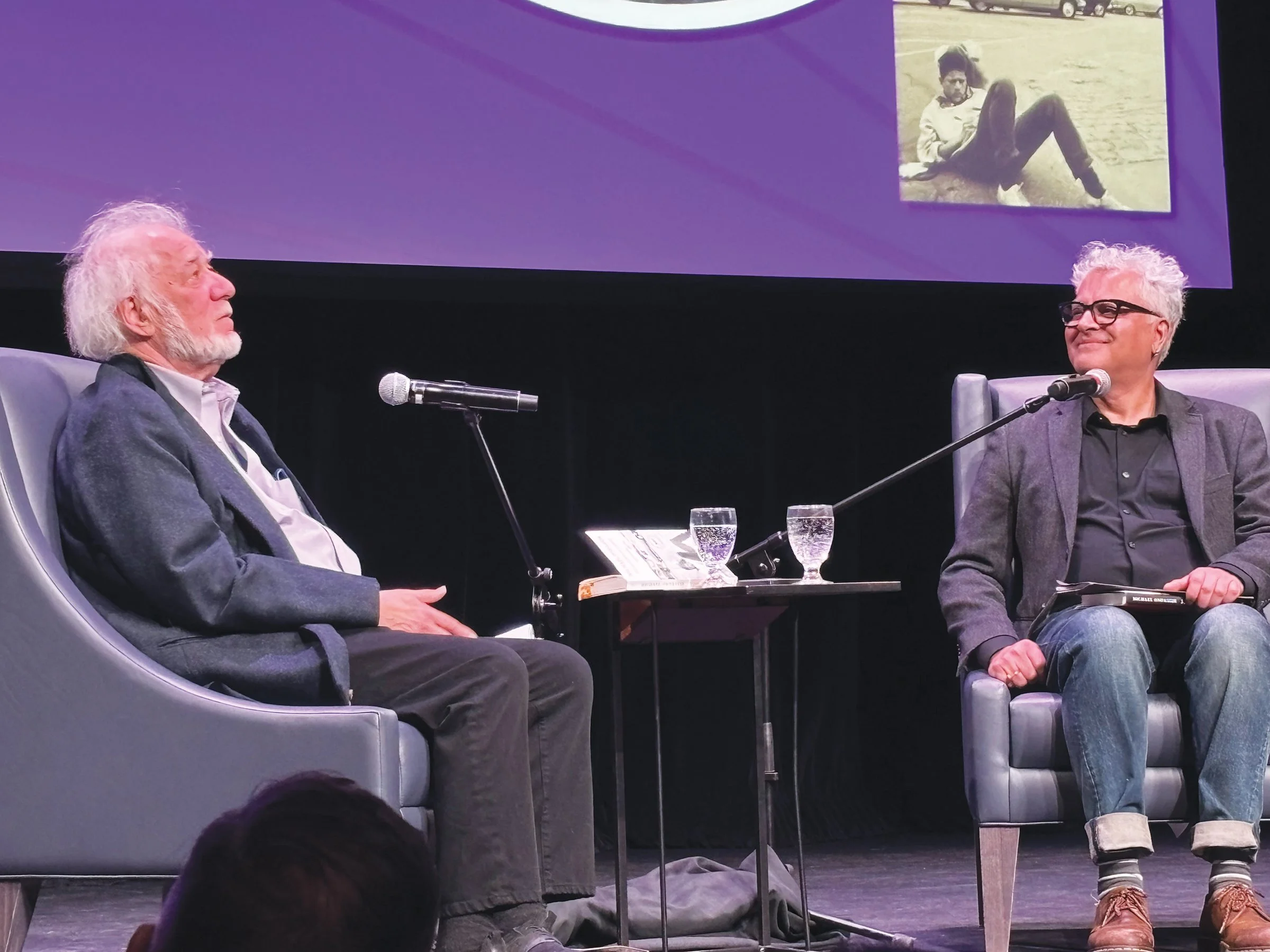
Michael Ondaatje in conversation with Amitava Kumar at a TIFA Presents event
By SHAGORIKA EASWAR
As we emerge from the depths of yet another “good old-fashioned Canadian winter”, it’s easy to wax lyrical.
It is blue-butterfly day here in spring,
And with these sky-flakes down in flurry on flurry
There is more unmixed colour on the wing
Than flowers will show for days unless they hurry
But these are flowers that fly and all but sing
And now from having ridden our desire
They lie closed over in the wind and cling
Where wheels have freshly sliced the April mire
From Blue Butterfly Day by Robert Frost.
Though I have sometimes wondered just what we gained by learning all those poems “by heart” as rote learning was known back in the day, when lines pop unbidden into my head, I know that we are a people with a deep love for poetry.
In all of its forms and avatars.
My cousin’s husband in Jaipur loves sher-o-shairi and has the perfect lines for any situation. Blessed with a phenomenal memory, he can quote from Ghalib to Zauk, and Faiz Ahmad Faiz to Bashir Badr. Dohas from Kabir or lines from Rumi.
Retired Prof DP Sengupta, who headed the Electrical Engineering Department at the prestigious Indian Institute of Science in Bangalore, and was a dear friend of my late parents, has a vast reservoir of poetry he quotes from. During one call, he recited lines from Thomas Gray’s Elegy Written in a Country Churchyard. I forget the context, but I will remember forever how he was able to recite the poem. In its entirety.
While as one who learnt those poems in school, I tried to keep pace with:
Full many a gem of purest ray serene,
The dark unfathom’d caves of ocean bear:
Full many a flow’r is born to blush unseen,
And waste its sweetness on the desert air.
Kaku, or father’s younger brother, as I call him, is also a font of Rabindranath Tagore’s poetry and has translated many of the Nobel laureate’s poems in Bangla into English. At almost 90, he is now working on the second volume.
On a visit to Canada in May one year, my cousin from India looked at the pools of liquid gold by the lake created by vast swaths of daffodils in bloom and gave an impromptu rendition of I Wandered Lonely As a Cloud by William Words-worth.
I wandered lonely as a cloud
That floats on high o’er vales and hills,
When all at once I saw a crowd
A host of dancing daffodils;
Along the lake, beneath the trees,
Ten thousand dancing in the breeze.
And it isn’t just what comes under the formal purview of “poetry”.
We respond with the appropriate lines from Hindi songs in so many situations, because Gulzar or Sahir Ludhianvi have said it so much better than we ever could, and those lines are encoded in our DNA.
Michael Ondaatje recently read from Selected Poems, The Distance of a Shout, at an event organized by Toronto International Festival of Authors (TIFA). He was in conversation with author and professor of English at Vassar College, Amitava Kumar, who is, as was obvious, also a fan of Ondaatje’s works.
The exchange was lively, and drew chuckles from the audience as the two lobbed memories of their previous encounters at each other. But a silence, punctuated by soft murmurs descended when Ondaatje read poems from the collection.
The poems offered an intimate glimpse into his life from those on old family photographs from his childhood in Sri Lanka to cherished relationships with friends and family.
The one called Bear Hug, about his son, a little boy then, waiting for a hug, was so vivid, I could see the child, arms outstretched, waiting.
Describing Ondaatje’s poems, Roland Gulliver, TIFA’s Artistic Director and CEO, wrote that it evocatively captures his poetic life from the 1960s to present day.
“For many of us, regardless of age, ‘appreciation’ of poetry began at school. Depending on your experience you can remove the inverted commas. Learning by memorizing became very unfashionable but those are the poems many people carried with them. In my educational upbringing in Glasgow in the 1980s, I had a fierce run-in with Robert Burns, attempting to learn Tam ‘o Shanter for a school competition when I was about 11.
“Learning Digging by Seamus Heaney and The Sun Rising by John Donne means I carry fragments of those poems with me today; lines anchored to a moment in time.
“Now we have multiple ways to consume poetry – on page, on screen, on audio – which opens up a whole different world of experiences and ways to access the work. My old friend Luke Wright can now be found on TikTok performing; there are poets forging careers on Instagram; The League of Canadian Poets can send you a daily poem to your inbox, Poetry Pause; there is an array of podcasts available, from The New Yorker: Poetry for contemporary poetry to the London Book Review’s Close Reading and On Being’s Poetry Unbound to dig into how the classic poems were made, and to bring down the barriers to enjoying beautiful words.
“We are surrounded by sceptics informing us that poetry is irrelevant, obsolete, aloof, but I have barely scratched the surface of where, how and why poetry is being made in 2026. Proof that, like the novel, poetry is at the core of how we tell the stories of ourselves.”
Lines from poetry that resonate with us are also not necessarily from ancient, long-gone poets – contemporary poets speak to us, speak for us, too. In the Meet section of the March issue of Desi News, Neena Jayarajan quoted Rupi Kaur: “I was not made with a fire in my belly so I could be put out”.
However, for some reason – and as far as I know – poetry is no longer taught in schools in junior grades. You have to take literature in high school and university. And likely don’t have to memorize anything.
While a young adult might certainly have a deeper understanding and thus appreciation of the language and the sentiments, aren’t they missing out on the joys of even simple nursery rhymes? Their parents certainly are!
I recall our son belting out Row, row, row your boat as a toddler.
His version always ended with “Life is butter cream”!
I called him on our way back from the reading to share how divine it had been to listen to Michael Ondtaaje read from his poems. “I can see that,” he said, quietly.
• To check out upcoming events at TIFA, visit festivalofauthors.ca.