
SENIOR MOMENT
A LIFE SHAPED BY MEDICINE, TEACHING, WRITING AND ADVOCACY
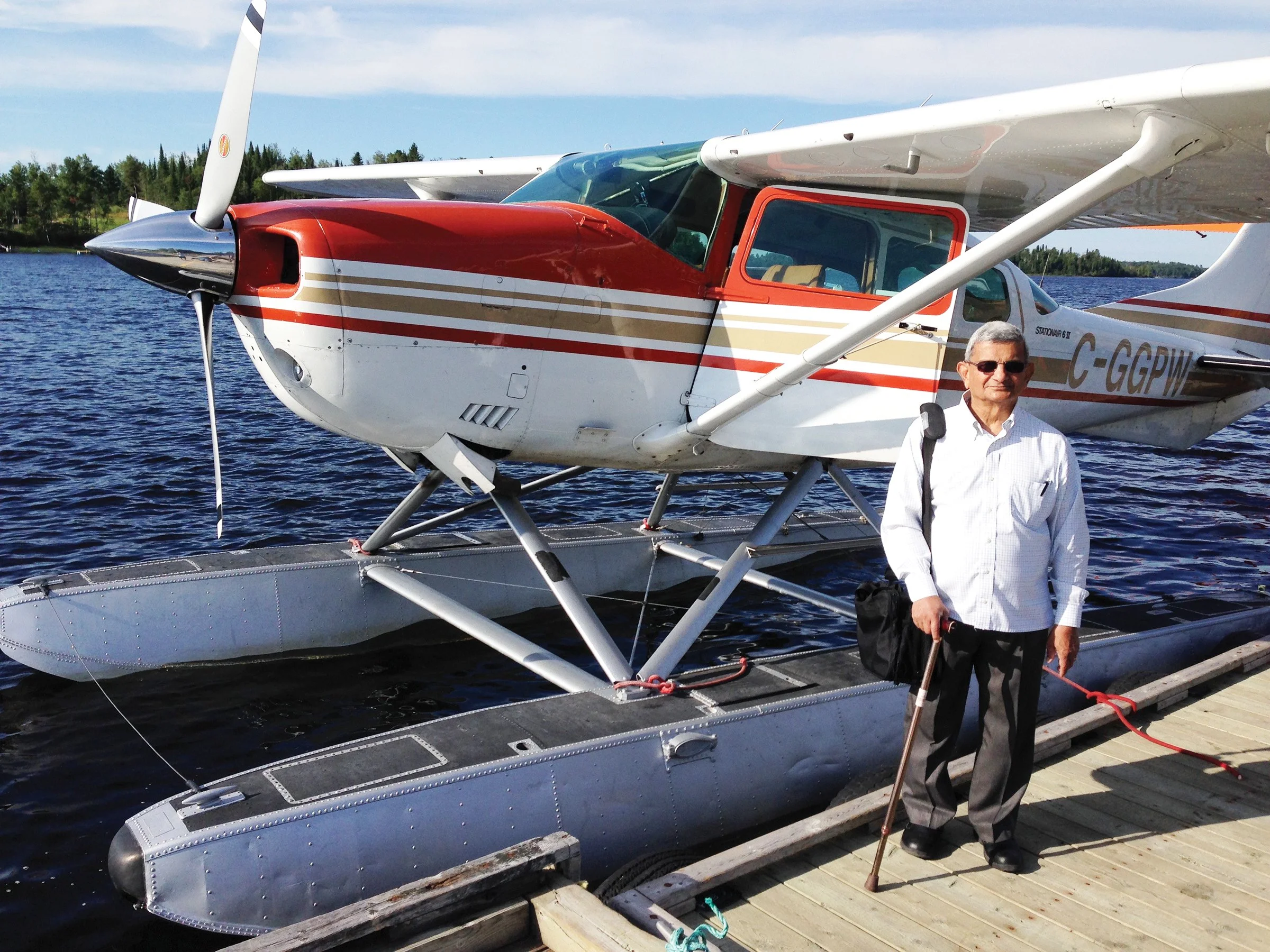
Dr Chandrakant Shah often visited remote Indigenous communities by float planes.
By CHANDRAKANT SHAH, MD
I am turning ninety this week and have decided to retire from writing my column, Senior Moment.
Over the past couple of years, I have immensely enjoyed expressing my views on diverse topics and have always appreciated the encouraging and insightful comments I received from my readers.
In this final article, I wish to share reflections on my life and some lessons I have learned that may guide and be useful to you on your own journey on Mother Earth.
I was born into a middle-class Jain family in a small town in India during the Second World War.
My father, a wise and respected businessman, was the sole breadwinner supporting a large family of fifteen children. He was well-read, and townspeople often came to our home in the evenings seeking his advice.
As children, we would sit near him, massaging his aching legs, and quietly absorb those discussions. From him, I imbibed the values of duty, tolerance, forgiveness, caring, and sharing.
I was also deeply influenced by Jain philosophy, particularly the practice of ahimsa – non-violence toward all living beings and toward the environment. Non-violence, I learned, is not limited to physical harm; it also includes the harm caused by thoughts and words.
I did not fully grasp its meaning until later in life. Practising ahimsa requires compassion, empathy, and conviction. I also developed willpower through disciplined living, which taught me self-control and focus. Growing up in a large family taught me to care, share, accept differences, and live in harmony.
Education, minimalism, and hard work were ingrained early in our lives.
Another major influence was living under British rule for the first eleven years of my life. The Gandhian movement for Swaraj – self-rule – helped me understand the importance of self-determination, a lesson that later informed my work with Indigenous Peoples.
Over time, I learned that while adequate money is necessary, it is not sufficient for happiness.
As a physician, I could have earned more through private practice, but I knew that would not fulfil me. I loved teaching, research, and advocacy for causes I believed in. Becoming a professor allowed me to combine all three. I realized early that research should not merely produce publications but should also improve healthcare delivery, especially for those who need it most. In my zeal to help others, I sometimes failed to recognize that I was neglecting my immediate family. I worked long hours, unintentionally depriving my wife and children of precious family time. From this, I learned that maintaining a healthy work-life balance is not just important, it is essential.
As I look back on my journey – from a small town in India to more than six decades in Canada – I see a life shaped by medicine, teaching, writing, and advocacy. Along the way, I have been both witness and participant in the struggles and changes that continue to define this country.
I have seen the resilience of Indigenous Peoples who, despite centuries of colonization, continue to uphold their languages, cultures, and traditions. I have seen immigrants, including myself, wrestle with identity, exclusion, and belonging and yet also enrich Canada with energy, creativity, and vision. I have seen spirituality, generosity, and community caring provide strength in times of stress and hope in times of despair.
Some key lessons stand out:
• Reconciliation is essential. Treaties are living commitments, and we are all treaty people.
• Identity is not fixed but evolving. Canada’s diversity is its strength, yet it must be balanced with justice for Indigenous Peoples.
• Health is more than medicine. Spirituality, compassion, and generosity heal wounds that pills cannot.
• Generosity sustains communities. When practised as “we” rather than “me,” it creates enduring legacies.
• Well-being is a shared responsibility. The health of our communities is tied to the health of our values.
• As the late Justice Murray Sinclair reminded us: “Reconciliation is not an Indigenous problem – it is a Canadian problem. It involves all of us.”
The same applies to identity, health, and human values – they are not issues for governments alone, but for each of us in our daily choices: how we listen, how we give, and how we build community.
My hope for Canada is simple:
• A Canada where Indigenous children grow up proud of their culture, with the same opportunities as any other child.
• A Canada where immigrants are not asked “Where are you really from?” but are embraced as full citizens from the start.
• A Canada where spirituality infuses daily living – with compassion, humility, and gratitude.
• A Canada where generosity is the norm, not the exception.
• A Canada where Peace, Order, and Good Government are not just words embedded in our constitution, but the compass of our choices.
Let us be a nation that listens before it speaks, that builds bridges instead of walls, and that finds strength in kindness, not power. May our legacy be one of calm courage – where every voice matters, and every soul belongs. This is the Canada we dream of – and the Canada we must always strive to be.
I have lived a deeply fulfilling life, enriched by a wonderful family, indigenous and non-indigenous friends and colleagues, my patients and all those I encountered along the way. My parting advice is to live by the five Cs: Compassion, Courage, Communication, Connection, and Consistency.
If you feel strongly about a cause, do not be a bystander, be an agent of change. Work to change what you believe needs changing. Above all, strive for balance in life and work.
If in my writings over the past years I have inadvertently hurt anyone’s feelings, I ask for your forgiveness.
My heartfelt thanks to Shagorika and Easwar, editor and publisher of Desi News, for offering me a platform to express my views and for their steadfast dedication to reconciliation, diversity, equity, and inclusion.
A WELL-DESERVED HONOUR
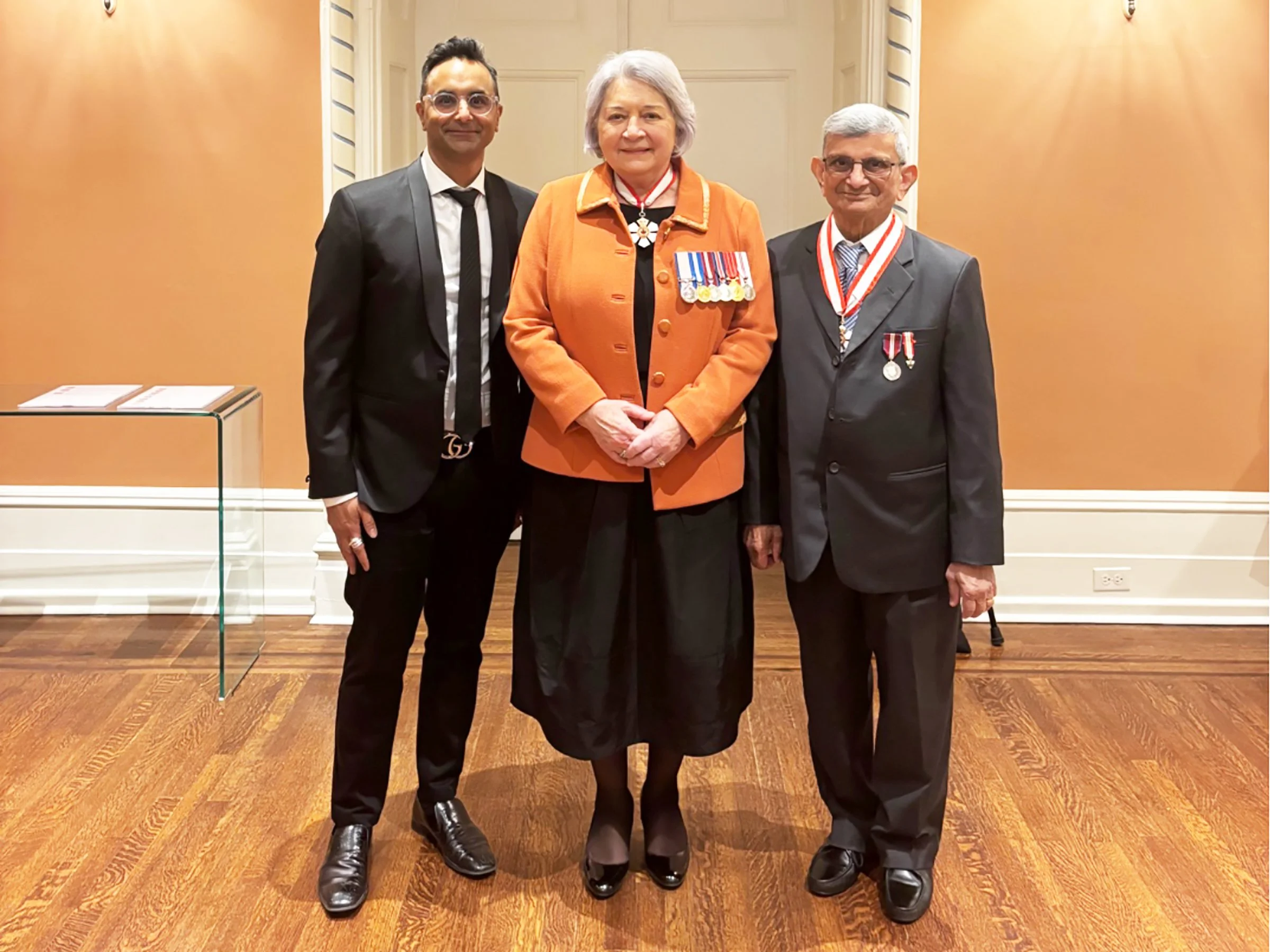
Dr Chandrakant Shah with Governor General Mary Simon and his son Rajiv in Ottawa last month.
In a ceremony at Rideau Hall, Governor General Mary Simon presided over a presentation of Canadian honours.
During this ceremony one Companion (C.C.), six Officers (O.C.) and 25 Members (C.M.) were invested into the Order of Canada; two Meritorious Service Crosses (M.S.C.) and 23 Meritorious Service Medals (M.S.M.) were presented as part of the Meritorious Service Decorations (Civil Division); and One Sovereign’s Medal for Volunteers was presented.
Dr Chandrakant Padamshi Shah, MD, FRCPC, O.C., O.ONT., Dr. Sc. (Hon) was appointed Officer, Order of Canada. O.C. recipients are those who have made outstanding contributions to Canada at the national level.
The Professor Emeritus at the University of Toronto’s Dalla Lana School of Public Health has transformed public health education nationwide and championed Indigenous health throughout his career. His advocacy reshaped Canada’s citizenship exam and established the country’s first endowed Indigenous Health chair, leaving a profound legacy of inclusion, scholarship, and systemic reform.
Dr Shah is an honorary consulting physician at Anishnawbe Health Toronto. He is the author of To Change the World: My Work With Diversity, Equity & Inclusion in Canada.
A well-deserved Order of Canada for Dr Shah!