
SPOTLIGHT
THE LIVING RAAGS OF SENI MAIHAR GHARANA
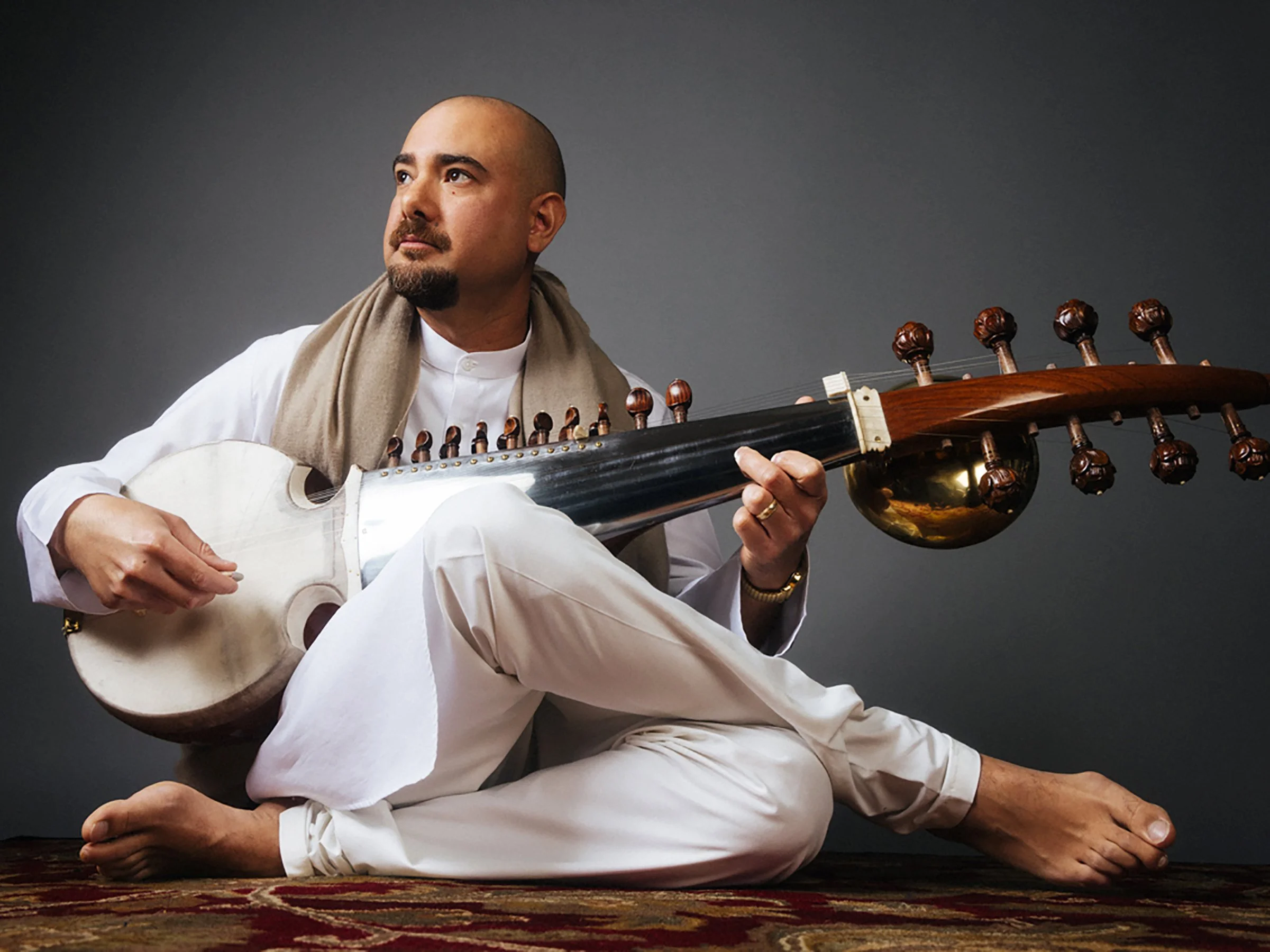
Ustad Alam Khan of the Seni Maihar gharana will be performing on April 18 at the Aga Khan Auditorium in Toronto.
By MOHAMED KHAKI
Partway through my phone conversation with Alam Khan, I asked whether he felt the weight of being the direct disciple of a music icon – his father and Guru, the Late Swara Samrat (Emperor of Melody), Ustad Ali Akbar Khan.
I had been somewhat hesitant to raise the question. It felt a little well-worn to pose it to someone in his forties who, from the age of seven, had trained under one of the most brilliant musicians in the realm of Hindustani raag sangeet. Surely, he must have been asked this many times since his legendary father’s passing in 2009.
Far from offering a scripted response, Alam answered with an emphatic yes. He spoke openly about the responsibility he has assumed as the Khalifa of the Seni Maihar gha-rana. A khalifa is typically the most senior musician within a gharana’s lineage, or a disciple explicitly designated as such.
Alam assumed this mantle following the passing of his elder brother, Ustad Ashish Khan, in November 2024.
“Whenever I perform a raag, I feel a responsibility to present its essence – to convey the gharana’s ethos, its approach to and treatment of that particular raag,” Alam told me. Having studied for years under his Guru, his commitment to the tradition is palpable.
As its name suggests, the gharana traces its lineage not only to the hometown of Alam’s illustrious grandfather, Ustad Allauddin Khan, but also to the great Mian Tansen, the court musician of the Mughal emperor Akbar in the 16th century. While Alla-uddin Khan’s early training came from his father and other musicians, his genius fully blossomed during his discipleship under the Rudra Veena maestro Ustad Wazir Khan, a descendant of Tansen.
Alam’s performance career took off when he began accompanying his father on international stages between 1996 and 2006. During this period, he performed at prestigious venues such as the Royal Jodhpur Palace, the Dover Lane Music Conference in Kolkata, New York’s Lincoln Center Jazz Festival, and in acclaimed concerts across the United States, Canada, Europe, and India.
While accompanying his father, Alam’s own solo career began to take shape around 1998. Since then, he has established himself as a true heir to Ali Akbar Khan’s legacy, earning praise from musical icons such as Ravi Shankar, Ustad Vilayat Khan, Pandit Shivkumar Sharma, and Pandit Buddhadev Dasgupta. He has also collaborated with some of India’s greatest tabla masters, including Pandit Swapan Chaudhuri, Ustad Zakir Hussain, and Pandit Anindo Chat-terjee.
In his father’s final years, Alam served as his personal assistant, helping with teaching at the Ali Akbar College of Music (AACM) in San Rafael, California – a hub for students and lovers of raag sangeet. Following his father’s passing, Alam became head of Indian Classical Instrumental Studies at AACM.
Despite these responsibilities, Alam wears his metaphorical crown lightly. He was remarkably open during our conversation, despite our not having spoken since his last performance on the Raag-Mala stage in 2013. At that concert, he played Madhu Malati – a raag composed by Ustad Ali Akbar Khan, who also created several others, including Gauriman-jari, Lajawanti, and one of my personal favourites, Chandranandan.
Beyond raag sangeet, Alam has collaborated with a diverse range of artistes across genres, including the Grammy-winning Tedeschi Trucks Band, Vijay Iyer, Blake Mills, Anoushka Shankar, Karsh Kale, Beats Antique, Bob Weir, the San Francisco Symphony, the Del Sol Quartet, and Jack Perla. He is also a founding member of the genre-bending group Grand Tapestry and the primary composer of The Resonance Between.
Alam received two nominations at the 2026 Grammy Awards (with Anoushka Shankar and Sarathy Korwar): Best Global Music Album (Chapter III – We Return to Light) and Best Global Music Performance (Daybreak).
And yet, from the way he speaks, raag sangeet remains his true love. “Baba used to say that music was meant to bless, not impress. You are not saying, ‘look what I can do,’ but rather inviting the audience to share in the blessing of the raag.”
This ethos is evident in his playing. Like his father, Alam unfolds each raag through unhurried, nuanced alaaps – marked by “tonal depth and dynamic range that express the personality of the raag, offering it as a musical blessing”, as he conveyed to me.
Alam recalled that someone once asked his father, “Do you rehearse before a performance?”
Khansaheb replied, “Do you rehearse before praying?”
It did not seem surprising, then, when Alam shared that he often feels, while performing, as though he is in conversation with his father – with the audience listening in.
Toronto audiences will have a chance to listen in on another such conversation on April 18, when Alam Khan performs with Salar Nader, the renowned tabla nawaz and senior disciple of the late Ustad Zakir Hus-sain.
When and where: April 18 at the Nanji Family Foundation Auditorium, Aga Khan Museum, 77 Wynford Drive, Toronto. Details and tickets: www.aga khanmuseum.org.
• Mohamed Khaki is on the Raag-Mala Toronto team.