
GRANT’S DESI ACHIEVER
A REALIST AND AN OPTIMIST
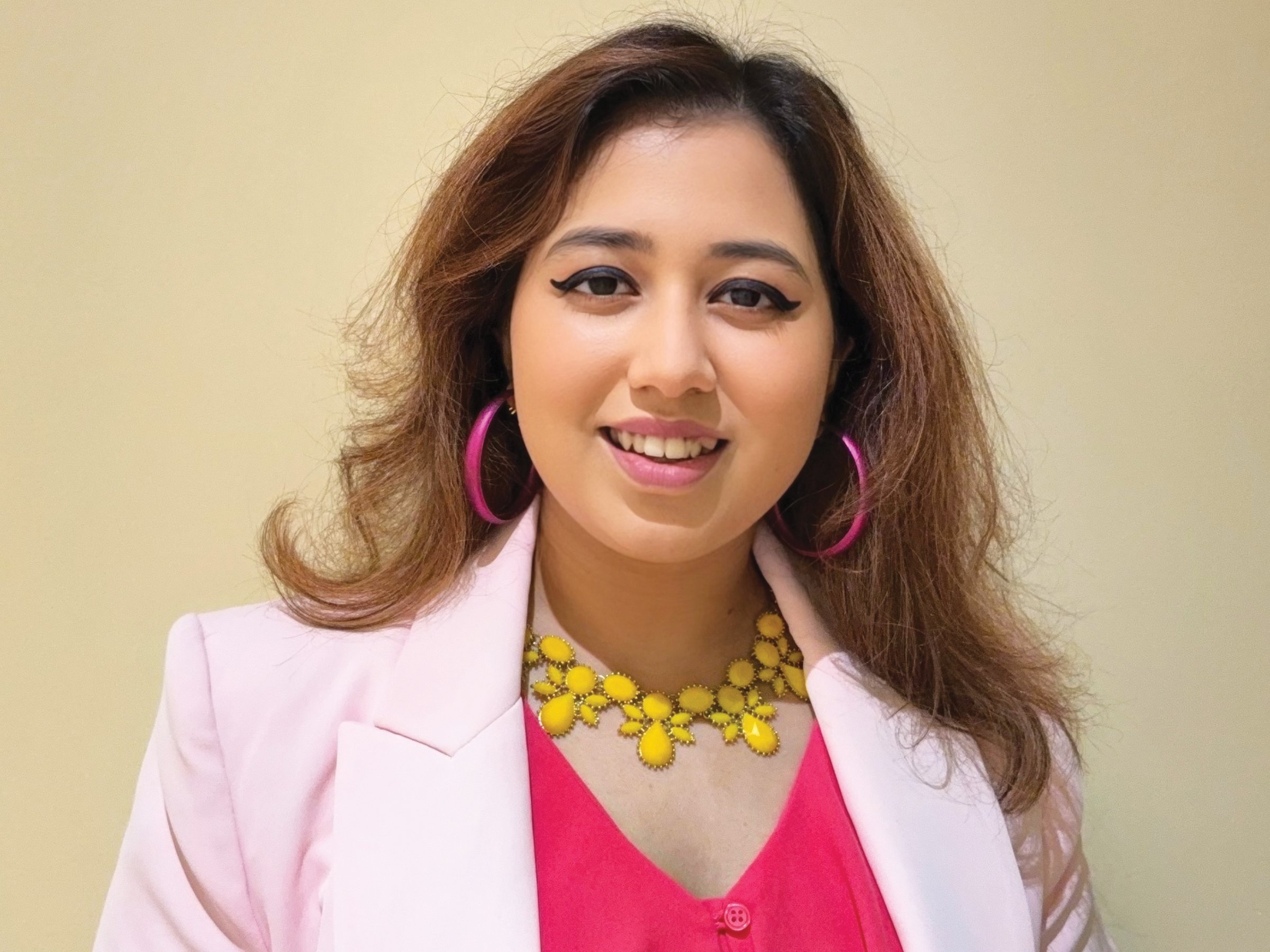
Kehkashan Basu is the founder of the Green Hope Foundation.
Grant’s is proud to present this series about people who are making a difference in the community.
By SHAGORIKA EASWAR
The list of awards and recognition Kehkashan Basu has chalked up in her 26 years is jaw-dropping.
Forbes 30 Under 30, Canada’s Top 100 Most Powerful Women, Canada’s Top 25 Women of Influence, Canada’s Meritorious Service Medal, UNCCD Land Hero, UN-Habitat Young City Champion, and most recently, YWCA’s Young Leader of Distinction. To name just a few.
“I grew up in a family where taking care of other people and the planet was the norm. I would accompany my parents when they’d distribute food and clothes to underserved communities. I’d spend time in my grandmother’s terrace garden, a mini ecosystem in an urban environment. I grew up thinking this is what everyone does. But when I was seven, I saw the image of a dead bird with its belly full of plastic and was deeply disturbed. I realized that I was seeing things through rose coloured lenses, but there were problems.”
She attended a lecture by environmentalist Robert Swan. His words, “The greatest threat to our planet is the belief that someone else will save it,” resonated deeply with her.
“My birthday falls on World Environment Day, June 5, so it was like this is what I was preordained to do! I planted my first tree on my eighth birthday. I started mobilizing children and adults within my community to take everyday actions to help those who needed it, help the environment, whether that was with food waste, water security, hazardous chemicals or helping underserved communities.”
Basu was invited to speak at the United Nations when she was 11. The following year, in 2012, she was invited to speak at the Rio +20 Earth Summit.
She talked about her work to restore degraded land by engaging other children her age. She sat in on negotiations and realized that of the 50,000 people present, only five including her were under the age of 18. There was a severe lack of representation from women, from vulnerable communities.
On her return home, she founded Green Hope Foundation to formalize the work that she was already doing.
“My dream wasn’t to create a big organization. I wanted to make a positive impact at the ground level, even if it was really small, and utilizing that, create long-term change. At a Walk for Water when I was nine I saw just how many children around the world were forced to walk every day to fetch water instead of getting an education. I told my mom that I want to be able to provide clean water to a community so that girls my age don’t have to do that. Then I learned about mass oil spills and entire communities being discriminated against as a result of their gender or their race. That knowledge was building up.
“Our first clean water system in rural Bangladesh was a culmination of the promise I made as a nine-year-old. That expanded with our solar water farms from Cambodia to the Caribbean. When we talk about providing solar street light, funders or people at conferences say it’s too small, think big. But sometimes the smallest change enables you to think big. If girls don’t feel safe going to school at dawn or returning in the dark, you’re limiting their dreams.
“We did STEM and STEAM workshops at the labs that we’ve built in Liberia, and it was wonderful to see the children thinking about their future and the future of their community.
“We have a very active chapter in Suriname. I remember seeing this girl, around 9 or 10, with a baby in her arms. She was looking through the window into the classroom with so much yearning in her eyes. My colleague there said that because of climate change, there isn’t that much work available within the community and the parents have to go further out for work, to fetch food and water and as the eldest daughter, the responsibility of caring for her siblings falls on her. We worked in Syrian refugee camps on the Lebanon-Syria border and have seen girls coming in with babies of their own or with younger siblings. It’s like their job is to care for everyone other than themselves.
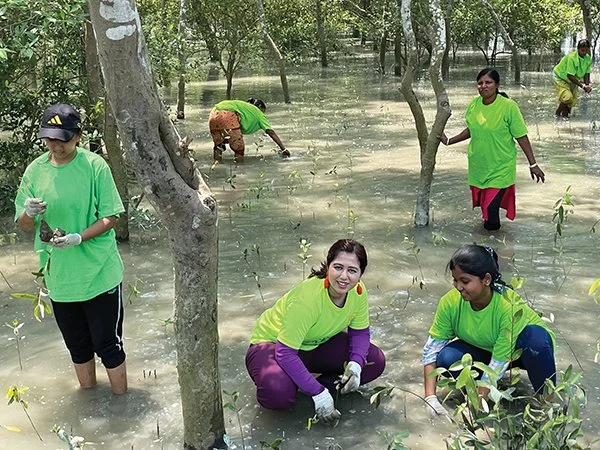
“Success is not about earning lots of money, but about what impact you create.”
“People talk about developed and developing countries,” says Basu. “That’s one facet. But food deserts and food insecurity exist not just in other parts of the world, but also within Canada. Newcomers, racialized and refugee communities are disproportionately affected.”
All of the produce grown at Green Hope’s organic, solar powered and solar irrigated farm is donated to food banks.
“We do field trips for students, particularly from underserved and underfunded communities. We also work with retirement homes, so it’s very intergenerational. Making sure that everyone has access to good food falls under our health initiatives – it’s not just physical well-being, but mental well-being as well. We call it harvesting harmony.”
Basu was named a National Geographic Young Explorer for her work on sustainability education. The Royal Canadian Geographic Society recognized her as an Explorer.
At the age of 11, she was a youth ambassador at the World Future Council and went on to become the youngest counsellor.
She was invited to speak at the Parliament of the World’s Religions in Toronto in 2018.
“That was really huge for me as a Bengali because I grew up hearing about Swami Vivekandanda’s speech at the first parliament in 1893,” says Basu, who was invited to be on the board when she was 20 – the first person below the age of 45 in that capacity.
She was a climate reality leader at 14 and now as a climate reality mentor she continues sharing the knowledge she has gained.
For her work towards a peaceful nuclear weapons-free society – with education, water, food, shelter as human rights – Basu was named a UN Human Rights Champion in 2018.
“Many of us don’t know that the uranium used to make the bombs that were dropped on Hiroshima and Nagasaki was mined in Canada by the Dene First Nations. They were not told what they were making, or that it was radioactive. And they died from radioactive poisoning. There’s all of the nuclear testing that took place in the Marshall Islands in the Pacific. All that radioactive material causing irreversible harm for generations. Our Green Hope campaign ‘We want books, not nukes’ focuses on disarmament education. Some claim nukes are for security. Whose security? Security is health, security is food, education, having a home. I spoke recently at the UN headquarters in New York at the nonproliferation treaty review conference on how all of the money being used for militarization could be used for actual security.”
Raising funds for all of these initiatives is their biggest challenge, admits Basu.
“Woman, young woman, young woman of colour, you see the funding gap expand every single time – grassroots organizations run by young women of colour are some of the least-funded organizations in the world. We get some grants, I put the honorariums that I get as a speaker towards Green Hope. Sometimes an individual sponsors certain projects, corporates also want to support us. But every single day we wonder, how are we going to pull this off. Somehow we find a way.”
She also debunks the pushy parent theory. “It’s wrong to think that children don’t understand or they’re too young to make a difference. I always knew what I wanted to do. I look back at my childhood self, and think, wow, that was one driven kid! I use my childhood self sometimes as an inspiration for when I’m dealing with logistical challenges or naysayers. I think about what little Kehkashan would have done, and then, go ahead with that ‘Yeah, of course we can do it!’ attitude. My mom’s a political scientist and a professor of international relations, but when she had gone into that field, people questioned the choice. So she was adamant that like she chose her own path and her parents supported her, I would get to choose mine. Same with my dad. He did his engineering from IIT Kharagpur and everyone said I should, too. He said, if that’s not what she wants to do, she doesn’t have to.
“That mindset is invaluable. Other family members were concerned about my choices, but as someone who focused on being at the top of my class while doing my MBA and MSM, I firmly believe that I was able to succeed because I was doing Green Hope Foundation’s work and had this exposure to real life outside.”
Basu’s parents moved to Canada in 2007 from Dubai where she was born. Her message for her fellow Canadian youth is that empathy is really important.
“Empathy and compassion for your fellow human being helps create a more equitable society. Educate yourself, your peers, family, community, and then turn that education into action. Recognize your privilege. Privilege is not extreme amounts of billionaire money. It’s having a home or having access to food, all of those things. Utilizing what privilege you do have for good.”
For parents: “Letting your child dream is so important. And redefining success as not about earning lots of money, but about being a good human being and what impact you’re able to create.”
For policymakers: “As someone who’s very much both a realist and an optimist, I would say there have been a lot of gains made, a lot of positive outcomes, but a lot more needs to be done. Canada is seen around the world as a beacon of hope for safety, sustainability, multiculturalism. But a lot more that needs to be done in terms of creating a more equitable society, a society that cares more for the planet. The minute we think we’ve done everything, that’s the minute we stagnate. Not we’ve done it, people love us. That mindset would definitely set us back.”
Kehkashan means the Milky Way or galaxy in Persian. A name that embodies shining like the stars. This young woman is living up to that, with her work impacting lives in far-flung corners of the world in countless positive ways.
• Grant’s is proud to present this series about people who are making a difference in the community. Represented by PMA Canada (www.pmacanada.com).
