
GRANT'S DESI ACHIEVER
“I GOT MY FIRST PAIR OF SHOES AT AGE 11”
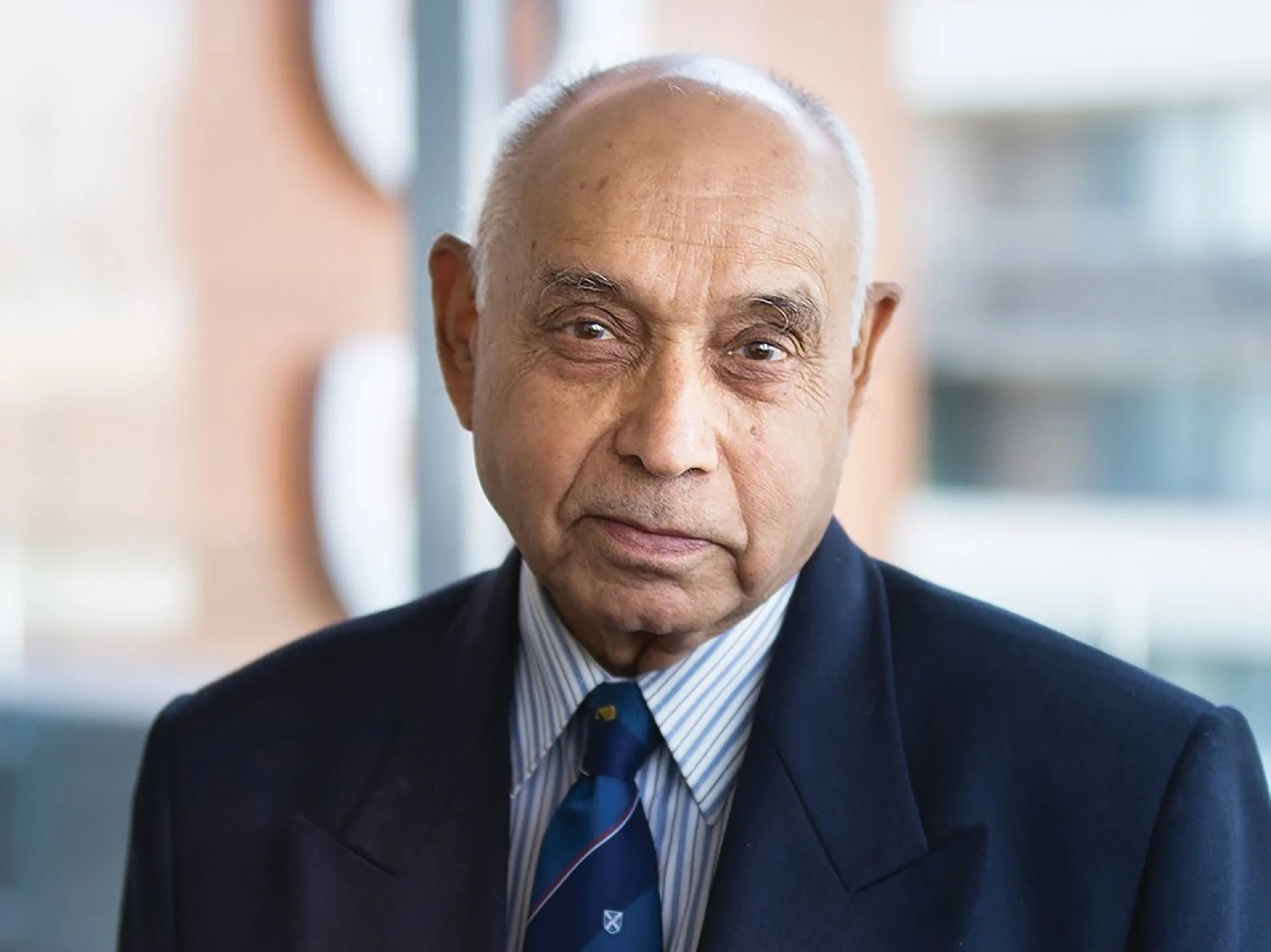
Prof Mahesh Chandra Sharma, Order of Canada, academic, philanthropist. Image credit: CONCORDIA UNIVERSITY.
Grant’s is proud to present this series about people who are making a difference in the community.
By SHAGORIKA EASWAR
Professor Mahesh Chandra Sharma received the Order of Canada at a ceremony in Ottawa recently.
He was recognized for his work as an academic and a civic-minded philanthropist and leader.
The string of letters after his name – P.Eng, C.Eng, M.Eng, MBA, FIMechE, FCMI, FIE(I), FIPlantE, FSOE, FIDiagE, FCSME, FASME, FRAS – attest to a life in academia.
The professor at the Department of Supply Chain & Business Technology Management, John Molson School of Business at Concordia University, explains the numerous postgraduate degrees including four from McGill alone, and membership of prestigious professional organizations thus: “I was born in a village in India in a very poor family. I got my first pair of shoes at the age of 11, until then I walked barefoot everywhere. The value of education was instilled very early in us. I came to Canada after completing my BEng in Mechanical Engineering to study more. I was enrolled in full-time courses, and attended evening classes. I got all the degrees between 1966 and 1984 while working, teaching and raising a family.”
As chief engineer and chief mechanical engineer at Sunds Defibrator, known internationally for the design and manufacture of various types of equipment for the pulp and paper industry, he led and managed a group of professionals who were responsible for the selection of mechanical equipment, mechanical design, preparation of specifications and drawings for all projects handled by the Roll Handling Division. As a head of department, he was responsible for complete project analysis, which included product analysis, financial studies, scheduling and cost analysis, etc.
As project engineer, Williams and Wilson Limited, he handled major projects for pulp and paper industry finishing rooms, his work involving cost analysis, estimation, design, manufacture, scheduling, etc. As design engineer at the same organization, he designed various types of material handling equipment for the pulp and paper industry and iron ore companies.
Prof Sharma designed the equipment for and conducted research on fully developed turbulent supersonic flows in straight and diverging circular pipes while working as Research Engineer at the Department of Mechanical Engineering at McGill University.
Prior to coming to Canada, Prof Sharma was foreman engineer (Aero-Cell) at the Research & Development Organization, Ministry of Defence, in India. Here he carried out extensive testing and prepared performance reports, drafted inspection procedures for industrial production, and prepared necessary specifications for final standardization.
As engineering designer at Air Headquarters, (HQ of Indian Air Force), his duties included procuring aircraft spares. This involved cost estimation, drafting of specifications for tenders, drafting of inspection procedures for quality control, etc.
He has presented his research at universities around world and his work has been published in peer journals.
He has received many prestigious awards including the Rotary International Distinguished Teacher’s Award; Outstanding Contribution to Student Life Award; Paul Harris Fellow, Best Polio Plus and Outstanding Rotarian from Rotary International and Provost’s Circle of Distinction.
He was Vice-Chair, American Society of Mechanical Engineers, Quebec Chapter and Chair, American Society of Mechanical Engineers (Quebec Section).
Prof Sharma teaches undergraduate and graduate courses in Operations Research, Production and Operations Management, Organization Theory, Engineering Management, Project Management, Finance and Economics for Engineers, Mechanical Engineering Designs, Theory of Machines, Gas Turbines Performance, Structural Designs, Statistics for Business, Mathematical Statistics for Engineers, Applied Engineering Mathematics, Aerodynamics, Project Management, Linear Models, and Numerical Analysis.
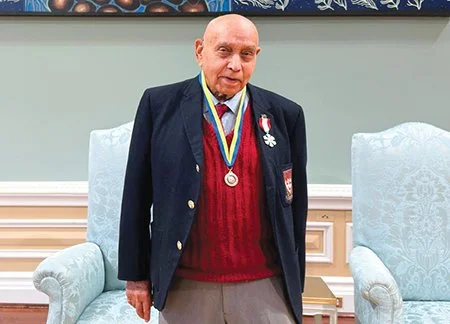
“Continuing education is a definite asset and community service is important.”
His research focuses on Project Management, Production Planning, Subsonic and Supersonic Aerodynamics.
He taught courses in supply chain management, recognizing its importance well before the significance of supply chains and their role in our lives was realized by many.
Prof Sharma has also been recognized as a Distinguished Teacher – one of five in the inaugural batch across Concordia in 1984 – for the length and quality of his teaching. He has since also been awarded the Lecturer of the Year and other teaching honours.
Contrary to popular belief that fewer female students sign up for STEM courses, Prof Sharma says the highest marks in his courses tend to be achieved by women.
“When I started, women constituted maybe 10 to 15 per cent of the total number of students, now, they are at 50 per cent or higher. Not so much in engineering, but in management, certainly. McGill and Concordia and the John Molson School of Business in particular, do a great job of supporting bright female students. And let me tell you, they work hard and are more disciplined! It’s wrong to keep women down. As Manu said, God dwells where women are honoured.”
With a PhD in Zoology, his wife Uma also taught at McGill. She, along with daughters Sandhya and Swati, and her mother were on the ill-fated Air India Flight 182 that had a bomb planted on it and exploded over the Atlantic in June 1985 taking the lives of all 329 people on aboard.
The tragedy almost broke Prof Sharma.
“I thought of committing suicide, I had nothing left to live for. Then it came to me that the best way to honour their memory was to live well, earn well, and ensure their names live on.”
To this end, he has set up several scholarships in all their names at McGill and Concordia and also at Royal West Academy, the school his daughters attended. One each for the top student in Math, Physics, Chemistry, etc.
It’s his way of honouring their memory, of propelling young minds towards a bright future that was so cruelly snatched from his daughters.
Also, ever since, every Sunday, for over 40 years, he has cooked at a local temple to feed 300-400 people.
“I am known to be a good cook!” he says. “Today, you’ll not find me depressed. I’m happy, I turned a personal tragedy into something that helps others, does some good.”
He has worked with Rotary International and was past president of the local chapter, and has raised funds to combat homelessness and for polio eradication, travelling to villages in India and Africa.
Prof Sharma also actively champions social causes supporting vulnerable individuals and the wider community. Through the Rotary Club of Montreal West NDG, Prof Sharma supports causes close to his heart including setting up a kitchen and shelter for Native Women who are experiencing homelessness, and has slept on the street when the temperatures dipped to below 30, for five nights a year, six years in a row now, to raise awareness about homelessness.
He came to Canada in 1966 from Delhi, to pursue his MEng in Supersonic Aerodynamics at McGill. “McGill had a great reputation in the field and it was hard to get in.”
Simultaneously looking for employment, he came up against the lack of “Canadian experience” barriers that newcomers continue to face today.
“At an interview, I said, ‘Canadian experience doesn’t grow on trees that I can just pick some, give me an opportunity to prove myself’.”
Within six months, the man who had interviewed him said Prof Sharma had more experience than him! On another occasion, he was dismissed when he pointed out the flaws in a certain design. Our steel is good, he was informed. Prof Sharma responded that steel was steel and went on to prove that he was right.
That newcomers continue to face much the same barriers so many years later points to the failure of Canada to attract, retain and utilize international talent, he says.
“Take internationally-trained physicians. In the US, they can prove their credentials, write an exam and can practise in their fields. In Canada, they are still faced with closed doors. We don’t have enough doctors, and yet, newcomer doctors face nearly insurmountable barriers to practising in Canada. Many of them give up after years of repeated attempts. I myself don’t have a physician. Our family physician retired ten years ago and since then, I haven’t been able to find one. And this is true in most of the provinces. Things are marginally better for engineers than they used to be, but still, you’ll find that more IIT grads choose the US over Canada. Why? More opportunities, more money. Canada is a rich country, but we don’t have enough manpower. We have the numbers, but not quality, trained professionals.
Speaking of his early years in Canada, Prof Sharma recalls the struggle sourcing ingredients for desi dishes. “I cooked my own food before my wife joined me. I love chillies and it was hard to find any! Also many of the dals were not readily available. But things got better with time.”
Asked for his advice to newcomers today on how to succeed in Canada, he says this question doesn’t have an easy answer.
“It varies from individual to individual. Canada offers a lot of opportunities, but you have to have patience. Success doesn’t come overnight. Continuing education is a definite asset, and community service is important. Be involved in your local community. Conducting research in a lab and publishing papers is important, too, but remember, most papers are only read by colleagues and peers and then archived. They don’t impact mankind in any tangible way. You have to make an honest effort to help to leave a mark. As Ghalib said, Rago mein daudte phirne ke hum nahin qayal, jab aankh hi se na tapka to phir lahoo kya hai? It means that passion only matters if it brings visible, intense pain. Emotions must be felt intensely, a commitment should be deep, for it to be of human, social relevance.”
• Grant’s is proud to present this series about people who are making a difference in the community. Represented by PMA Canada (www.pmacanada.com).