
MY TAKE
MY FRIENDS HAVE SUDDENLY DISCOVERED HOW SPECIAL CANADA IS
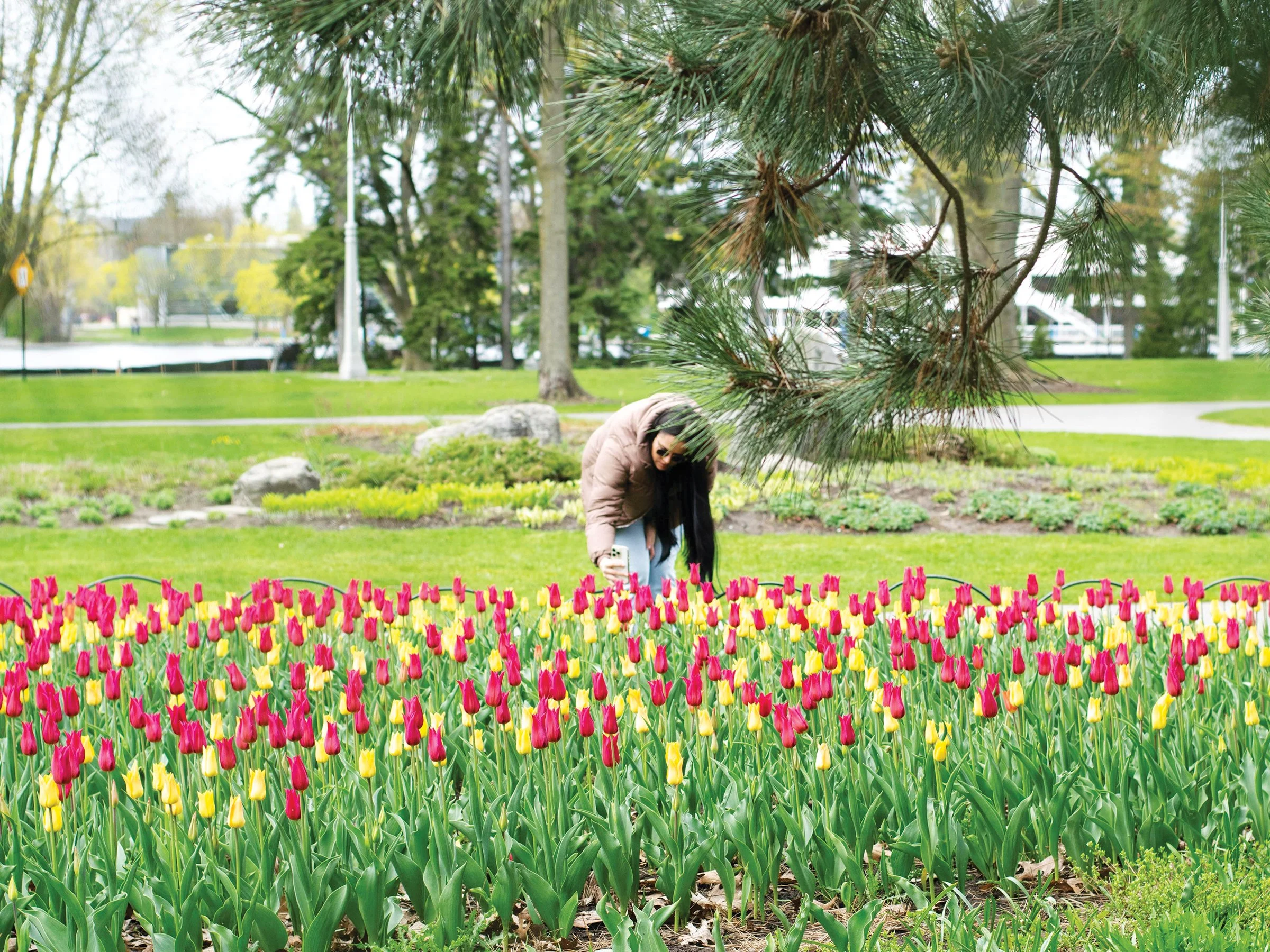
Walk through the nation’s capital in May and it’s like being transported to the Yash Chopra movie Silsila – you expect to see Amitabh Bachchan and Rekha singing Yeh kahaan aa gaye hum yoon hi saath saath chalte – with fields of tulips stretching as far as the eye can see. Image credit: SANDRA IVLEVA on Unsplash.
By SHAGORIKA EASWAR
You know the story of the gift of tulip bulbs from the Netherlands, expressing gratitude for Canada having helped Crown Princess Juliana, heir to the Dutch throne, who escaped Nazis with her two young daughters to England, then continued across the Atlantic to Canada?
It goes like this, according to information posted on Ottawa Tourism:
Ottawa’s connection to tulips dates back to World War II. Following the Nazi Invasion of the Netherlands, Princess Juliana of the Netherlands took refuge in Ottawa along with her two young daughters, Princess Beatrix and Princess Irene. While in exile in Canada, Princess Juliana gave birth to her third daughter, Princess Margriet. At the time of the baby’s birth, part of the Ottawa Civic Hospital was declared Dutch soil, to allow the new princess to hold Dutch nationality exclusively. Ottawa also helped to celebrate the princess’ birth by flying the Dutch flag at the top of the iconic Peace Tower and playing Dutch music on the tower’s carillon. Ottawa was home to these Dutch royal family members until they could finally return to a liberated Netherlands in 1945. Canadian troops played a pivotal role in the liberation as well.
Upon returning to the Netherlands, Princess Juliana sought to thank Ottawa and the Canadian people with several gifts, including 100,000 tulip bulbs. Since then, the Dutch royal family has sent tulip bulbs to Canada’s capital each year – now 20,000 bulbs – a lasting gift known as the “Tulip Legacy” which inspired the festival. 2020 marked the 75th anniversary of this Gift of Tulips, and the end of World War II. In honour of this landmark year and lasting friendship, a special Liberation75 tulip was created to represent the relationship between Canada and the Netherlands.
Walk through the nation’s capital in May and it’s like being transported to the Yash Chopra movie Silsila – you expect to see Amitabh Bachchan and Rekha singing Yeh kahaan aa gaye hum yoon hi saath saath chalte – with fields of tulips stretching as far as the eye can see.
But why mention this now, when the 2026 festival is behind us and next one a good ten months away?
Because two of my old school friends sent me the story recently, independent of each other. Both expressed amazement at this beautiful tale of friendship, and what can be achieved when two nations work together. It’s like the world – or at least my world – has suddenly awakened to how special Canada is.
I responded that I had shared the same with them in our early days in Canada when I first heard it. But when I am done teasing them about having joined me in my “sieve of a brain” days, I can’t help but reflect on how this tale serves as the perfect example of what Canada is like. Gentle, courteous, welcoming. And people who underplay all of these qualities with a trademark self-deprecating humour.
Staying with the theme, I share with my friends the story of the cherry trees in Toronto that treat us to clouds of fragrant blossoms in April/May.
In 1959, Tokyo presented Toronto with 2000 cherry trees, 100 of which were planted in High Park. They were accompanied by the technical chief of Tokyo Parks to ensure the successful planting of the fragile young forest in Toronto.
This first gift was followed by two more gifts and subsequent plantings.
As highparknature.org reveals, “A total of 2000 cherry trees were presented to the citizens of Toronto by the Japanese ambassador to Canada, Toru Hagiwara. They were given on behalf of the citizens of Tokyo in appreciation for Toronto’s acceptance of relocated Japanese Canadian refugees. Robert Kadoguchi, the eventual founding president of the Japanese Cultural Centre, was instrumental in arranging the shipment. He described the gift as “a tangible expression of Japan’s gratitude to Toronto for accepting us warmly during the distressing period of the Second World War and the years immediately following the termination of hostilities.”
These certainly were magnanimous words to offer a city that actually made things so very difficult for Japanese Canadians to settle in Toronto. Perhaps the gratitude is directed to the many Toronto residents and organizations that condemned the discriminating laws and racist attitudes, and stepped up to help innocent Japanese Canadians settle, find work and avoid deportation. No Japanese immigrants were allowed into the country as new Canadians until 1967.
So this is more the perfect example of what Canadians are like – people who step up to right a wrong, regardless of the politics of the day.
Like all those who sponsored Syrian and Afghan refugees. Or the lady who stood up at a community safety meeting and asked the panel of representatives from the police force, mental health services and agencies dealing with victims of violence, how to word the discourse around homeless people.
“I know some people think they can be violent, but I want to tell them that not every homeless person is violent,” she said. “Can you tell me how to do that?”
People applauded her question.
My Canada is one where a policeman escorts a family of geese, helping them cross a street in downtown Toronto safely.
But it’s not all sweetness and sunshine, of course it isn’t.
The wrongs perpetrated against Indigenous Peoples and the disenfranchised are a stark reminder that the history of any nation is complicated, even one as young as Canada. Métis-Cree academic and author Jesse Thistle’s memoir From the Ashes and Jack Whalen’s Invisible Prisons written with Lisa Moore are just two graphic and gut-wrenching examples. How did we let this happen?
This is not about glossing over dark chapters. But I take hope from the fact that we acknowledge the wrongs and attempt to make amends. Ask those who are suffering and we have a long way to go. It maybe just baby steps, but the desire to fix things is genuine and we’re moving in the right direction.
When reports of international students being treated badly in Canada appear in Indian media, extended family members and friends who were considering sending their kids to Canada for higher studies reach out for clarification. They also want to know if we are safe. They know we have been here for decades and our sons are done university, but were people who look like us also being targeted?
“We’re hearing of rising tension against Indian origin folks,” wrote one. “Hope you guys are in a safer locality and don’t face that kind of trouble, from afar one always worries more.”
We were all absolutely fine, I assured her.
Always have been, in all our years in Canada. Not every report presents a balanced picture. I feel bad when I see some reports because they might dissuade genuine students who were coming here on genuine visas to study at genuine, legit designated learning institutions (or DLIs as they are known). There are thousands of others who were lured here by shady immigration consultants and the stories of hardship international students suffer, though genuine and heartbreaking, tend to be more about them.
We’ve been in our current home 15 years now – the only desis on the street and one of very few in the area – and have always felt welcomed.
Our neighbours, many of whom have become close friends over the years, walk by in the summer and tell me which flowers from my garden they would like me to share with them! And one of them created the most gorgeous Christmas planters for our porch as a thank-you.
We also exchange home-baked goodies and small gifts with our neighbours over Christmas. When we are away in winter, they come shovel the driveway. We lived in our previous home for 16 years (again, the only desis on the street and one of very few in the area) and are still in regular touch with those friends.
Our kids have gone to school together and we’ve watched them grow, get married, and have kids of their own. One knitted the sweetest booties for our granddaughter when she was born and another gave us a beautiful Afghan that she made.
Newcomers face huge challenges, but there are also the phenomenal success stories of people from the community in every possible field – many of whom rose from very humble beginnings.
Just this morning, as I was out weeding, my neighbour walked across with a “summer offering” of gardening gloves.
Not a word about the ratty ones I was using – they are so comfortable! – just that she had picked up a bulk pack and wanted to share.
Quintessentially Canadian!
Happy Canada Day!
HUMOUR ME, CANADA

Image credit: HANNA PAD on Pexels.
I first read and laughed my way through How To Be A Canadian as a relative newcomer. But it has grown on me and now, on revisiting it, as I still laugh out loud, I also connect with it more, as I recognise the nuances and traits the brothers Ferguson make such unholy fun of.
They take readers on a romp through Canada, poking fun at every province along the way.
Under Canada’s Official Dress Code, you will read, “To fully blend in with local inhabitants, you will need to dress like a Canadian. Some suggestions include saris, kimonos, Jamaican tie-dyes, Peruvian ponchos, Indonesian sandals, Albanian sweaters and brightly coloured fez caps.
“Anything goes, and the more contradictory, the better.
Everything from our fascination with the weather to apologizing for everything is covered.

How To Be A Canadian by Will Ferguson and Ian Ferguson is published by Douglas & McIntyre, $19.95.
There’s a whole chapter devoted to saying sorry. In twelve different ways. From the simple sorry and essential sorry to the unrepentant sorry and authentic sorry.
It should be compulsory reading for all – but then that wouldn’t be Canadian, eh? Canada, Fergusons inform us, is a nation of cajolers.
“Why not, eh?” is classic Canadiana, they write. “A strong demand. A second thought, and then a tagged on postscript to soften the blow.”
However, read this and judge for yourselves:
Not to oversell it or anything, but How To Be A Canadian is the greatest guidebook ever written. It will explain everything you’ll ever need to know. It will change your life and improve your posture and cure cancer.