
COVER STORY
SPOT THE FOOD BANK USER

Food banks in Canada witnessed nearly two million visits in 2024. Nearly 20 per cent of the visitors were employed. Steady income no longer guarantees food security. Image credit: LEO VISIONS on Unsplash.
By SHAGORIKA EASWAR
• There were 1.5 million visits to food banks in Ontario in March 2022.
• There were 3.49 million client visits to Toronto food banks in 2023 – nearly 1 million more visits than the year prior and a 273% increase since pre-pandemic.
• York Region food bank said in a news release that in the first two months of 2024, compared to the same period last year, the number of children served by its network went up 24%.
• More than 37% of people helped by food banks are children and nearly half of the households helped have children. 32% of food bank visitors last year were under 18 years old.
• Between April 1, 2024, and March 31, 2025, 1,007,441 people accessed food banks during a total of 8,712,897 visits. Marking a 165% increase from 2019-2020.
• Kingston, Ont., declared an emergency as roughly 1 in 3 households struggled with food insecurity in December 2025.
• According to Food Banks Canada, more than 1 in 5 Canadians report going hungry, with 23% saying they are eating “less than they should”.
• 1 in 8 Canadians struggle to access the food they need.
• Over 75% of Ontario food bank survey respondents reported having less than $100 left each month after housing costs, and 22% had housing costs that exceeded their monthly income.
• For newcomers to Canada and racialized groups, the numbers are even lower, hovering around $3 left per person per day for food.
• Nearly 1 in 3 food bank clients (29%) went a whole day without eating and half (50%) missed a meal to pay for something else.
• The number of people using food banks in Ontario has reached another record high with over one million people accessing emergency food support last year, according to a report from Feed Ontario – a collective of hunger-relief organizations.

“Hunger in Canada will not be solved through food charity. It requires concerted action from all levels of.government.” Image credit: SURINDER PAL SINGH on Unsplash.
A random selection of statistics from news reports shows that the numbers, the need, just keep going up and up.
“It is unfathomable that the number of client visits to food banks is now higher than the City of Toronto’s entire population,” Neil Hetherington, CEO, Daily Bread Food Bank, was quoted as saying.
What really puts a face to these stark statistics are stories of quiet desperation.
Jatin Kohli (name changed to protect privacy) says he’s unable to sleep at nights, wondering if he’ll be able to feed his family of four the following week.
The recent arrival is working as a security guard while his wife attempts to pass the qualifying exams that will allow her to practise as a dentist. Only after that will the engineer focus on his own career. And until then the bills have to be paid.
The kids needed winter clothing, that took up a chunk of money.
“And they grow so fast, they probably won’t even fit in those jackets and boots this coming winter,” he says with a rueful laugh.
Meena (who didn’t wish her last name to be used) purchases packets of tortillas when they go on sale.
“I fry some onions, add some salt and chilli powder, throw in a can of kidney beans and I have rajma with roti for a couple of meals.”
The international student is aware that a 10-kg bag of atta would last much longer, but as someone who shares a basement apartment with three other students and has limited access to a small kitchenette, that’s not an option for her.
“Where would I keep it?”
Food prices have been going up steadily these past few months, and have been, at some points, the highest in over 40 years. While we attribute it to the rise in fuel prices due to the US-Iran conflict, the truth of the matter is that the prices have been rising and the need growing, for years.
With everything from bread, eggs and milk to fresh produce costing significantly more, even the basics are getting difficult to afford for many people.
Experts quoted in the media suggest shopping with a grocery list in hand and meal prep. I read that and think that other than impulse shopping – of which there isn’t much happening for a person on a shoestring budget – and emergency runs to the store, most people must already be doing that. Isn’t a list the most obvious place to begin? Even those that didn’t do so before, who just did unplanned grocery runs as and when the need arose, aren’t they likely to be doing so now?
Drawing up lists and then moving a few items to next week, fingers crossed. Comparison shopping, moving to cheaper, store brand alternatives, snagging specials and making large batches of soup, etc., from seasonal, slightly cheaper produce and freezing some for later.
Many people do all this routinely, have been doing so for years. Others are new to it, either because it’s the saner way to function or because it’s better for the wallet and the planet, as it cuts waste. But there remain a staggering number of people for a so-called First World country with social networks in place, who are finding it difficult to put food on the table, to feed their family two nutritious meals a day.
Food insecurity is gaining ground.
With rents being non-negotiable, people cut back where they can.
Discretionary spending on the nice-to-haves, the vacations. Even dining out is on hold – many restaurant owners talk about the challenges associated with a dropping clientele. But a healthy, nutritious meal is out of reach for far too many people. And then there are pets. A report in the Toronto Star detailed the heartbreak of a family that had to abandon their beloved three-year-old dog after losing a job and their home.
But even people with homes and jobs are relying on food banks. In an article in Newmarket Today, Elizabeth Keith quoted pastor Andrew Hamilton who has noted a changing trend in people coming to his church’s weekly community barbecue.
“They come here because otherwise they wouldn’t have lunch,” he says.
“With rising food costs, soaring rental rates, and inflation numbers at an all time high, more and more people are, unfortunately, turning to a food bank,” said Adrian Bain, executive director of the Newmarket Food Pantry.
He said the majority of food bank users have less than $100 left after paying their housing costs.
In another article Elizabeth Keith wrote about the community fridge run by the Newmarket Food Pantry which provides 24/7 access to fresh food and pantry items for people in need. It operates non-stop, even amid snowstorms and wintry weather.
On any given day, there are about three volunteers at the fridge, which is located outside the Newmarket Public Library, one delivering food picked up from local businesses and two cleaning shifts. There is a roster of about 45 volunteer cleaners and 15 drivers who give their time to maintaining the fridge.
No one plans to need a food bank but more than half a million people visit a food bank in Ontario every year, according to Feed Ontario.
No one plans to retire without enough to get by. Many seniors living on a fixed income don’t have enough to afford basic necessities like rent, utilities, transportation, or food.
No one plans to be unable to feed their children. A healthy lunch provided at school could be the only meal some children receive all day. At home, parents may skip a meal so their child doesn’t go hungry.

Food insecurity impacts all ethnic backgrounds, people who are originally from all corners of the globe. From South Asia, South East Asia and the Middle East, from the Caribbean, Africa, North and South Americas. Image credit: JOSHUA THOMAS on Unsplash.
The comfortable retirement that so many Canadians thought they could look forward to is becoming increasingly more unstable. The decline in employer pension programs, barriers to accumulating personal savings, and the widening gap between income provided through government pension programs and the rising cost of living is resulting in more seniors falling into poverty. When their retirement savings and benefits fall short of meeting their monthly expenses, more seniors are turning to food banks for help.
Maple Leaf Centre for Action on Food Security is committed to working collaboratively across sectors to reduce food insecurity in Canada by 50 per cent by 2030. Sarah Stern, leader of the centre, provides these eye-opening statistics on food insecurity across the country:
“Food insecurity is a reality for one in eight households in the country, and it forces hardworking people to compromise the quality and quantity of the food they buy for their family so they can pay fixed expenses like rent and heat,” explains Stern.
People with inadequate access to food are 10 per cent to 37 per cent more likely to die prematurely from any cause other than cancer compared to food-secure people according to an article published in Canadian Medical Association Journal (CMAJ).
The average life expectancy in Canada in 2008-2014 was 82 years. Those experiencing severe food insecurity died nine years earlier than their food-secure counterparts.
Food insecurity is something staff and volunteers at food banks across Canada witness every day.
It impacts seniors, people of working age and children. International students, people working multiple jobs to make ends meet, and people with university education...
They come from all ethnic backgrounds, people who are originally from all corners of the globe. From South Asia, South East Asia and the Middle East, from the Caribbean, Africa, North and South Americas. People who have been here for generations and also newcomers. People with all levels of education, from low to high. Those with mental health issues or with significant challenges at home.
Some of the primary reasons people turn to food banks include sudden illness of family members, job loss and family break-up. People with physical or mental health issues, indigenous peoples, immigrants and refugees are especially vulnerable to food insecurity.
Seniors are nearly twice as likely to need the assistance of a food bank on a long-term basis compared to adults under 65 years of age.
Children continue to be one of the largest groups of food bank users in the province with a significant number of Ontario children relying on food banks and school nutrition programs. Studies have shown that childhood hunger is linked to negative academic and health outcomes, including impaired learning and decreased productivity, and a higher risk of mental health challenges and chronic conditions like asthma. Beyond that, studies have shown that the impact of childhood hunger can create a ripple effect that ultimately makes it more difficult for children who grow up in poverty, to escape poverty as adults.
Children and youth are nearly twice as likely to access a food bank than adults.
And all of them are hungry for change.
“Hunger in Canada will not be solved through food charity; it requires concerted action from all levels of government,” says Stern. “For too long, food banks have borne responsibility for responding with emergency food relief, but this is not a sustainable solution.”
However, they are much-needed for now, and individuals can help.
Donate to a food bank either monetarily or food items they have on their wishlist.
Volunteer time!
More info at: feedopportunity.com, www.sevafoodbank.com, pchs4u.com/programs/langar-on-wheels and https://5n2.ca/donate.
FOOD FOR ALL IS SEVA
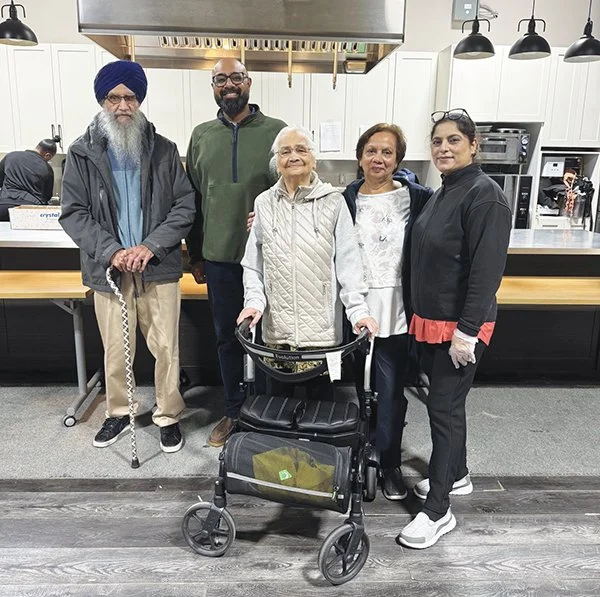
Two seniors, both over 90, recently visited Seva Food Bank’s Malton kitchen and insisted on making a donation. Over 1000 disadvantaged families rely on Seva Food Bank. Image credit: SEVA.
Seva Food Bank opened its doors in 2010 with one simple goal: to serve with compassion, dignity, and love.
An initiative of Sikhs Serving Canada, it addresses the challenges of food security and underlying poverty to spur economic renewal in Mississauga, Ontario.
Through its three locations, it ensures equitable access to safe, nutritious and culturally appropriate food to people experiencing or at risk of poverty in the communities it serves.
They believe access to food should be a right, not a privilege.
With the cost of living at an all-time high, many seniors are struggling to afford basic necessities such as food, says Seva’s Executive Director Vipin Saini. “Seva Food Bank provides a safety net and alleviates the burden of worrying about where their next meal will come from. Hunger can be devastating, leading to serious problems such as malnutrition, illness, and decreased productivity. Thousands of individuals struggle to have consistent access to enough food to live a healthy life. Our food bank plays a vital role in the lives of over 1,000 families who rely on us every month for healthy, nutritious food. However, the demand for our services is increasing.”
Over 15 years, Seva has:
• Served over 130,000 families.
• Distributed nearly 9 million pounds of food.
• Mobilized over 7000 volunteers.
• Grown from one location to three – expanding access to food, programs, and connection across the region.
• Launched programs that support newcomers and job seekers.
In a recent appeal for non-perishable essentials, Seva Food Bank wrote that they were short on everyday essentials: Tea bags, sugar, rice, snacks.
“These are not luxury items. These are everyday essentials families depend on. Just a few weeks ago, a box of tomatoes cost around $20. Today, we are paying nearly $60 for the same box. Rising fuel costs are increasing transportation prices.
“While we manage rising costs for fresh items, you can help us keep shelves full. Sarbat da Bhala means well-being for all. We say this phrase often. But ‘all’ is not a small word. ‘All’ is a very large set.
“It includes people who share our faith. And people who do not.
“People who look like us. And people who do not.
“People whose traditions we understand. And people whose traditions we may never fully know.
“When we say all, then care cannot come with filters.”
“Last month, your generosity helped us serve 1200-plus families across Mississauga.”
The Seva team also shared this sweet story:
“Recently, something truly beautiful happened at our Malton kitchen. Two of our seniors, both over 90 years young, came to visit us. Not for an appointment. Not for help.
“They simply wanted to see ‘where the hot meals you make possible come from’. They walked through our kitchen, side by side. They saw meals prepared with care, packed thoughtfully, and delivered with dignity every single day.
“When the visit ended, they reached into their pockets and insisted on making a donation.
“We gently said no. They smiled and said, ‘Let us also do our part.’
“Because of you, seniors receive two fresh, hot meals every day, delivered to their homes at no cost and with dignity.
“Behind every meal is care. Behind every delivery is respect. Behind it all is you.
“Right now, more seniors are relying on daily meal delivery than ever before.”
There is an analogy they often share at Seva. When you join Seva whether as a donor, volunteer, or supporter, you don’t become part of a safety net. You become part of a springboard.
A safety net catches you but a springboard lifts you. “With your support, families regain their footing and rise into a brighter future.”
Seva Food Bank is a registered Canadian charity. Tax receipts are issued for donations of $20 or more.
Seema David founded 5n2, a non-profit soup kitchen, in 2013. The organization strives to minimize hunger, poverty and food insecurity in the Scarborough community, working with partner organizations to bring fresh, warm meals to local residents, serving at food banks, shelters, seniors buildings, apartment buildings and drop-in centres.
They’ve continued to expand their operations in order to keep up with the growing needs surrounding hunger and food insecurity.
Another program they offer is the 5n2 Food Pantry. They partner with agencies including Second Harvest, Scarborough Centre for Healthy Communities, and other community leaders, to supply free groceries for individuals who make less than $34,000 as their annual income. And unlike traditional food banks where clients line up for hours on end, their free Food Pantry grants each client a 15-minute visit. Their pantry service provides the liberty to select food items and they even have a steady supply of rescued meats. Pantry2Go just consists of volunteer drivers delivering the pantry items directly to people’s residences instead of people having to come to the physical pantry. Their Food Pantry is structured to give people the freedom and dignity to choose what goes on their table and in their families’ mouths.
5n2 EdU is a program created for seniors to help them better navigate the modern world with workshops on how to use technology. These sessions highlight how to read nutritional value charts and food labels in order to help live a healthier lifestyle. Most importantly, the program minimizes the isolation many elders face due to their exacerbated health risks during and after the pandemic. 5n2 EdU was a very successful program but was forced to pause as they were evicted from their original location and are now in the process of relocating.
5n2 Meals2U was created for those who are unable to commute or leave their residence due to health concerns, disabilities, or mobility issues. Volunteer drivers deliver groceries and freshly prepared meals from their kitchen staff to homes all across Scarborough with up to 300 meals being delivered per week.
Every donation brings 5n2 closer to creating their vision of equitable access to food support in marginalized communities.