
GRANT’S DESI ACHIEVER
EMPOWERING WiTH EMPATHY
Grant’s is proud to present this series about people who are making a difference in the community
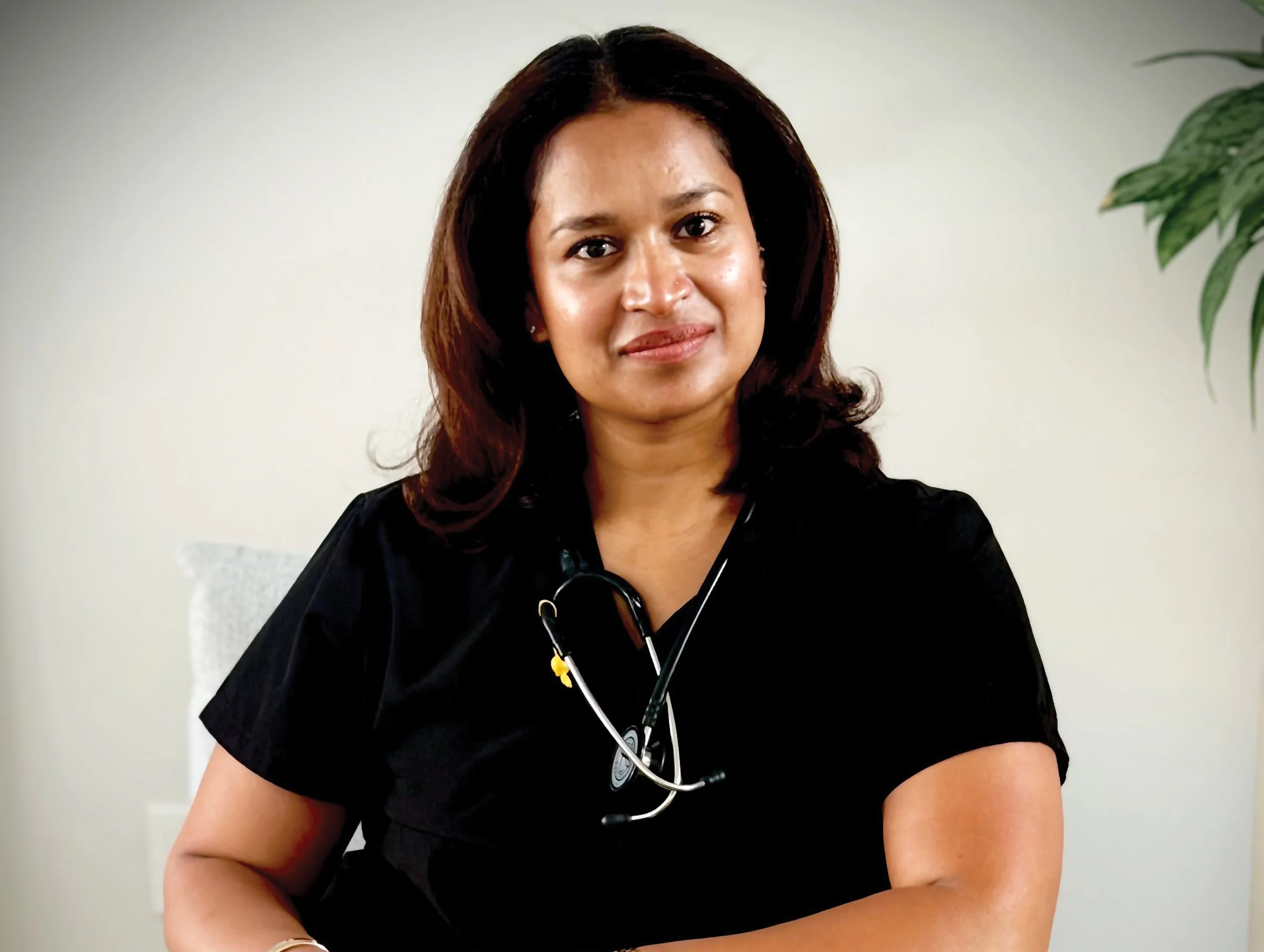
Dr Gaiathry Jeyarajan, MD, FRCPC, is a psychiatrist, author, and public educator.
By SHAGORIKA EASWAR
Dr Gaiathry Jeyarajan, MD, FRCPC, is a psychiatrist, author, and public educator dedicated to raising emotionally resilient and culturally confident children through storytelling and advocacy.
She specializes in trauma and PTSD, with a “larger focus” on women and children, on IPV and intergenerational trauma.
Many adults are struggling with micro trauma, and may not even be aware of how it might be rooted in their childhood experiences, she says.
“Parents weren’t intentionally harsh, they were in survival mode. So this is not about blaming parents, but trying to understand.
“I started my family when I felt financially and emotionally secure. I planned. But I realized what’s it really like when my children were born. I thought, oh, this is what it would have been like for my mom.
“Our parents’ generation had the support of the people in the community, of grandparents. We have research and studies, and we know toddlers can’t change, parents have to. I am an adults’ psychiatrist, but anxiety or depression often involves childhood history. I’m working to see what I can do to help the next generation. If we intervene early enough, we can help prevent a host of mental health issues.”
Dr Jeyarajan currently serves as a lecturer at the University of Toronto.
She provides emergency and crisis care at a local GTA emergency department when someone suicidal, psychotic or needing other help is brought in. She is also a member of the Assertive Community Treatment (ACT) team which visits patients who may not be able to make it to appointments, doing check-ins, assessments, bringing medicines, etc.
She ascribes her interest in advocating for anti-oppressive, community-centered care to her early years in Scarborough, to wanting to give back. At a local cultural community center, she witnesses the day-to-day struggles of the large immigrant population. Access to healthcare is affected by culture, she notes.
“I have my own singular cultural lens and I make sure I’m not making assumptions. I ask questions about their lived experiences as immigrants or refugees, their generational experience in the current environment in Canada. I do in-depth consultations, I give them the time. Only then do I come up with a plan. You can’t just say ‘Set boundaries’ or recommend cutting off contact when the person is seeking help navigating a thorny relationship. You can’t just say ‘Go for therapy,’ you have to look at social determinants. You have to be collaborative and respectful of a person’s situation.
“Maybe someone is not getting promoted at work – repeatedly. Hearing something like, ‘Maybe it’s not your time,’ is very invalidating to someone experiencing barriers within the organization, or systemic barriers. You have to get their perspective.”
Culturally-sensitive practice is important to her. Sometimes a parent will hit their child because it’s something they themselves have grown up with, they see it as a form of disciplining, of tough love. A lot of the times it’s anxiety-driven.
“They want us to focus on our academics, to succeed, and so many of us do really well, that the two get coupled,” says Dr Jeyarajan. “But I believe spiritually we were not put on this planet to abuse. I tell them to decouple beating and success. To think of the millions of very successful people who were not hit. I ask them if they would hit an adult, or even a pet. But to be loving and consistent in your parenting, you have to be in less of a survival mode. It can take years of therapy to overcome these behaviour patterns.”
Dr Jeyarajan is trying to break the cycle in its infancy. To prevent abusive behaviour before it begins by showing parents what it is and providing the language and tools to change.
Bullying is learned behaviour, she says.
If the child is not bullied at home, he or she will not accept it as the norm when it happens outside of the home.
“The first time they are bullied or hurt, they will stop it or seek help.”
To facilitate the conversation, Dr Jeyarajan wrote children’s books that translate complex mental health concepts into accessible, culturally relevant stories for families (see book reviews on page 25).
Her books show parents how to connect the dots between a child’s speech and emotions.
“If your child’s performance is suffering or the child says he or she is sad every day, seek help,” she says. “If you’re in doubt, trust your gut. Go talk to your family physician.”
Canada’s recent fall to 25th place in the 2026 World Happiness Report, is being attributed, at least partly, to heavy social media use.
Dr Jeyarajan adds that the pandemic was a “big event” for mental health, and the ripple effects are still being felt. The economic impact on families, remote learning with no physical interaction with their peers, the inability to read expressions on teachers’ faces with masks on when they did return to the classrooms, all impacted younger children during stages when huge leaps in bonding and attachment are taking place.
As for slightly older children and teens who are always on their devices, being in a fantasy world also had repercussions. Parents, also on their devices, are unavailable and so what Dr. Gabor Maté calls “peer orientation” takes place, she says.
“Earlier, there was a gap between school and home. Now kids are in constant touch with other kids, sharing info. Clicks on anything can change your algorithm and a child who clicks on say, racist material, even once, will get more and more of the same while corrective interactions at home have been eroded. So it’s not the phone, it’s what we’re allowing our children to do with their phones that’s the issue.”
Build connections, she urges. And avoid shaming. Even unintentional, it can have a negative effect.

“No matter when someone immigrated, nobody will tell you it’s easy. Recognize this and ask for help.”
“If you make a mistake, apologize. Don’t compare your child’s performance to that of others. Emphasize that you want them to reach their full potential, not someone else’s idea of success. Remember what you would do if you hurt an adult, even unintentionally. You’d try to repair the relationship. Do the same with your child when you make a mistake.”
She also talks about a whole other issue – fear-mongering. Among parents. Stories and “reports” that say normal, everyday interactions can cause harm.
“I keep coming across stuff like ‘If you rush your child as they’re leaving for school, it will cause anxiety’. Well, if a child is getting late, you have to tell them to stop diddle-daddling! Anything that comes from a place of bonding is effective and does not tend to cause harms. I tell parents that if they go into this material with knowledge and confidence, there are a lot of great resources online. But we know how to parent, how to treat another human being, trust that instinct. And question these ‘experts’, question the veracity of the ‘studies’ they quote.”
On the flip side, social media has made it possible for people to become more open and share their challenges with mental health, Dr Jeyarajan points out.
Her family came to Canada in the 1990s fleeing the war in Sri Lanka.
“We came as refugees, and we came in parts, not as a whole family,” she says. The family settled in Scarborough. It was hard for a young girl whose first exposure to schooling in Canada was in grade 9. Racial slurs were used, comments such as “You smell funny, why don’t you go home and take a shower?” The experience inspired her to write a book about bullying and curry.
However, raised by a mother who was “traditional but liberal” and fearless in navigating a new country experience as a single mother, she brushed it off.
“I was very focused academically, I tuned out a lot of those noises. I was also feisty! But you come home and you know you’re different. You don’t have all the cool stuff other kids have – we were a large family and money was tight. The psychological impact is that you feel you’re lesser. You have to shine in a group to be noticed. You’re aware of discrimination. It’s hard to put a finger on it but you’re aware you don’t belong. And that’s why it’s so important to feel loved at home. I didn’t have a victim mindset.”
Those early experiences inform the work of the University of Toronto-trained physician and psychiatrist. “I take a few minutes to ground myself before every appointment. Every interaction with a patient is an opportunity for contact with kindness, and making a small shift. It’s not what you say, but how you make them feel. People generally come in at a very low point in their lives, when they’re feeling raw, and I may not be able to fix everything at one shot but if we have a gentle interaction, if they want to come back, I see that as a win. I’m grateful.”
As a parent, she’s helping her six-year-old navigate her cultural identity with confidence.
“She wears a bindi to school!” shares Dr Jeyarajan. “You’d never have caught me with a bindi. And oh, my name – I heard so many versions of it that it was easier to go with whatever someone came up with instead of making each conversation about my name. But my daughter’s experience is different. She’s able to frame the questions as curiosity.”
Dr Jeyarajan tells those who see a role model in her to ask for help. And to be okay with many refusals.
“A lot of what I have in my life is because I asked. I got many nos, but I persisted and found the people who wanted to help. Who saw me. No matter when someone immigrated, nobody will tell you it’s easy – every decade had its challenges. Expect mental health challenges. Studies show that newcomers are happier than the rest of the population, but that wanes when reality sets in. Social isolation, the first winter, challenges finding meaningful employment, all these take a toll. Recognize this and seek help.
“Help is available, and Canada is a land of hope and opportunity.”
• Grant’s is proud to present this series about people who are making a difference in the community. Represented by PMA Canada (www.pmacanada.com).