
SPOTLIGHT
A VOICE CARRYING CENTURIES
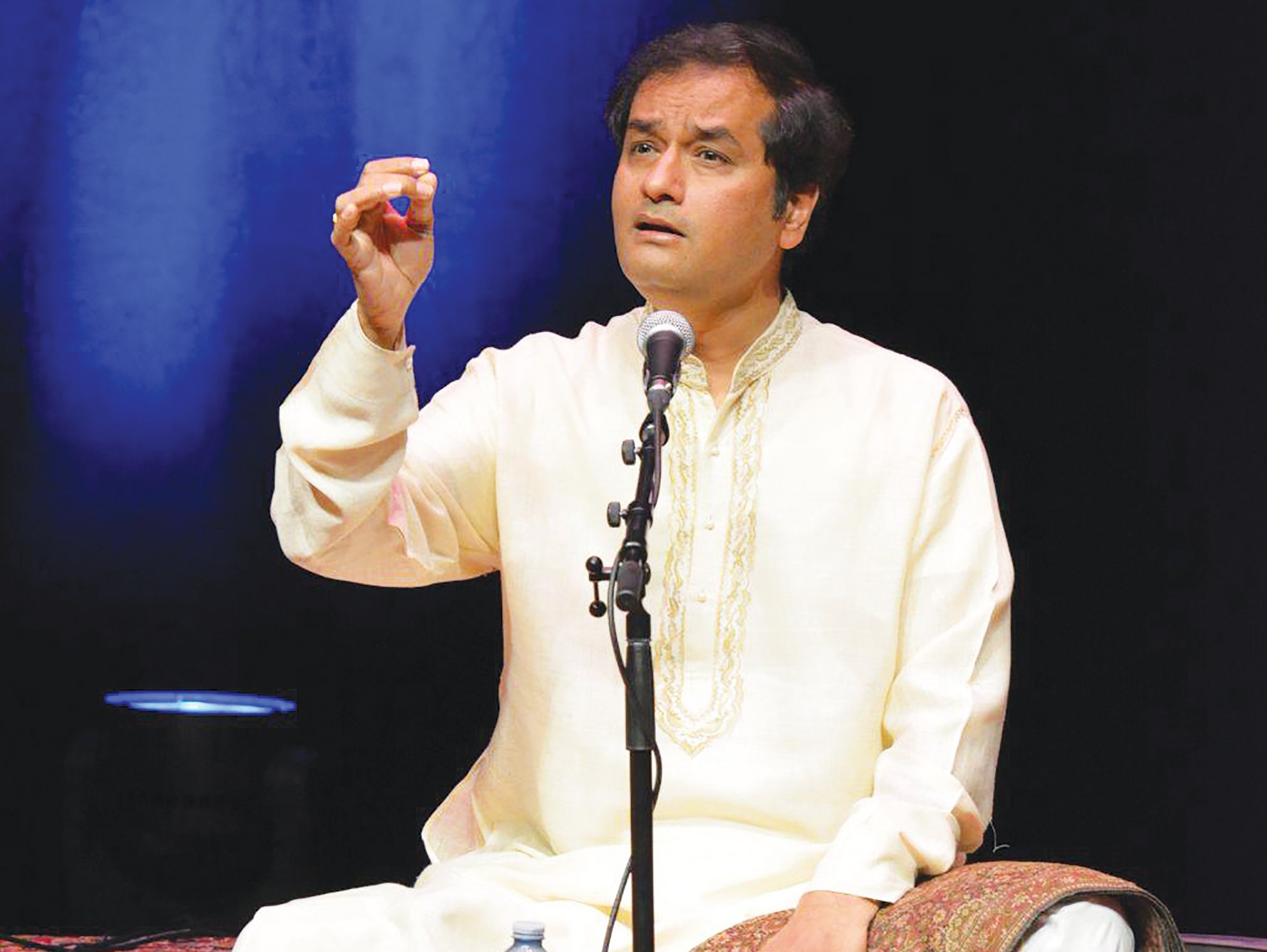
Pandit Uday Bhawalkar is one of the foremost Dhrupad vocalists in the world today.
Please note! The concert venue has changed. Scroll down to the bottom of this page for details.
By NISHANT PAREKH
In an age of instant gratification, there exists a music that insists on silence before it speaks – so ancient it remembers the cadence of Vedic hymns, so uncompromising that it asks both performer and listener to dissolve the self entirely.
That music is Dhrupad, the oldest surviving genre of North Indian classical music. And among its most dedicated living custodians is Pandit Uday Bhawalkar, a voice that carries within it the traditions of centuries.
At Raag-Mala Toronto, we have long believed that Dhrupad is not merely to be heard, but encountered – as an entry point into the philosophical and spiritual core of Indian civilization. Our relationship with Uday ji goes back to 2015, when his rendering of Raag Todi left an indelible impression: a morning raga unfolded with extraordinary patience, suffused with pathos, devotion, and a quiet, unyielding intensity.
On May 30, he returns to the Raag-Mala mainstage, in partnership with the Aga Khan Museum. It is an occasion that carries both artistic and personal resonance. I still recall driving him to a recording studio years ago, listening as he spoke – without affectation – about his life, his gurus, and his years at the gurukul of Ustad Zia Fariduddin Dagar. Moments like these illuminate the deeper truth of Dhrupad: it is not learned in fragments; it is lived.
The word Dhrupad derives from dhruva (fixed, eternal) and pada (word or composition). It is widely regarded as the oldest form of North Indian classical vocal music, with roots in the chanting traditions of the Samaveda, extending back several millennia.
Yet Dhrupad is not simply an ancient relic. It is, at its core, a discipline of sound as spiritual practice – nada yoga. The music functions simultaneously as meditation, invocation, and artistic expression. Historically, it evolved from the earlier Prabandha tradition, moving from Sanskrit into medieval Hindi and Brajbhasha, and from temple contexts into royal courts – without ever relinquishing its sacred orientation.
As Uday ji himself observes: “When immersed in the note and raga, the self disappears and music takes on its own existence.”
A Dhrupad performance is defined by its austere clarity and structural integrity. It begins with an extended alaap – a slow, unmetered exploration of the raga that can last for an hour or more; though less so for most modern audiences. There is no percussion, no rush toward resolution. The voice moves deliberately, inhabiting each note, revealing its microtonal shades and internal tensions. Remarkably, this alaap is sung on the ancient mantra Om Anant Hari Narayan – something Pandit ji shared with me personally.
Only after this meditative unfolding does rhythm enter, with a composed bandish set to cycles such as chautal or dhamar, accompanied by the pakhawaj. The architecture of the composition – sthai, antara, sanchari, abhog – offers both discipline and expansiveness.
Central to this practice is nada yoga: the cultivation of resonance within the body, allowing the voice to access a vast spectrum of tonal colour. In the Dagarvani style – today the most widely practised – notes are not fixed coordinates but fluid, living entities, continuously shaped in relation to one another.
To understand Uday ji’s music is to understand the lineage that shaped it. The Dagar gharana, spanning nearly twenty generations, has been central to both the preservation and revival of Dhrupad. Its modern renaissance is closely associated with the senior Dagar brothers – Nasir Moinuddin and Nasir Aminuddin Dagar – whose jugalbandis brought the form back to international attention in the twentieth century.
Uday ji entered this lineage through rigorous training under Ustad Zia Fariduddin Dagar and Ustad Zia Mohiuddin Dagar, undergoing more than a decade of immersive study in the guru-shishya parampara. This was not merely musical training, but a disciplined reorientation of perception – toward listening, toward time, toward sound itself.
Born in Ujjain in 1966, Uday ji has spent over four decades as one of the foremost exponents of Dhrupad. His style is unmistakably Dagarvani: unhurried, architecturally precise, and spiritually grounded. He is known for his expansive alaap, his clarity of swara, and his ability to sustain raga bhava without recourse to ornamentation or speed.
In a musical culture that often rewards virtuosity and immediacy, this restraint is quietly radical. It demands attention. It demands surrender.
Beyond performance, Uday ji has played a vital role in transmission – teaching at institutions such as the ITC Sangeet Research Academy in Kolkata and mentoring a small group of dedicated students in the traditional mode. The scale is intentionally limited. Dhrupad does not lend itself to mass dissemination; it must be transmitted, one voice at a time.
We live in a time defined by speed, compression, and distraction. Dhrupad offers something radically different: a structured pathway to stillness. Its tempos are slower than the human pulse; its silences extend beyond our habitual tolerance.
And yet, it is precisely in that extended attention – in that willingness to remain – that something essential begins to reveal itself.
For those who have experienced Uday ji in performance, the memory lingers not as spectacle but as presence. As the first notes of the alaap emerge – eyes closed, voice rising from deep within – the experience resists easy description.
Perhaps the closest word is one drawn from the tradition itself: darshan – not merely seeing, but being in the presence of something that alters you.
• Nishant Parekh is President, Raag-Mala Toronto.
NEW CONCERT VENUE - DATE UNCHANGED!
When and where: May 30, at the new concert venue right next to the Aga Khan Museum: Ismaili Centre, 49 Wynford Drive, Toronto. Details and tickets: www.agakhanmuseum.org.