
GRANT'S DESI ACHIEVER
A QUANTUM ENTANGLEMENT
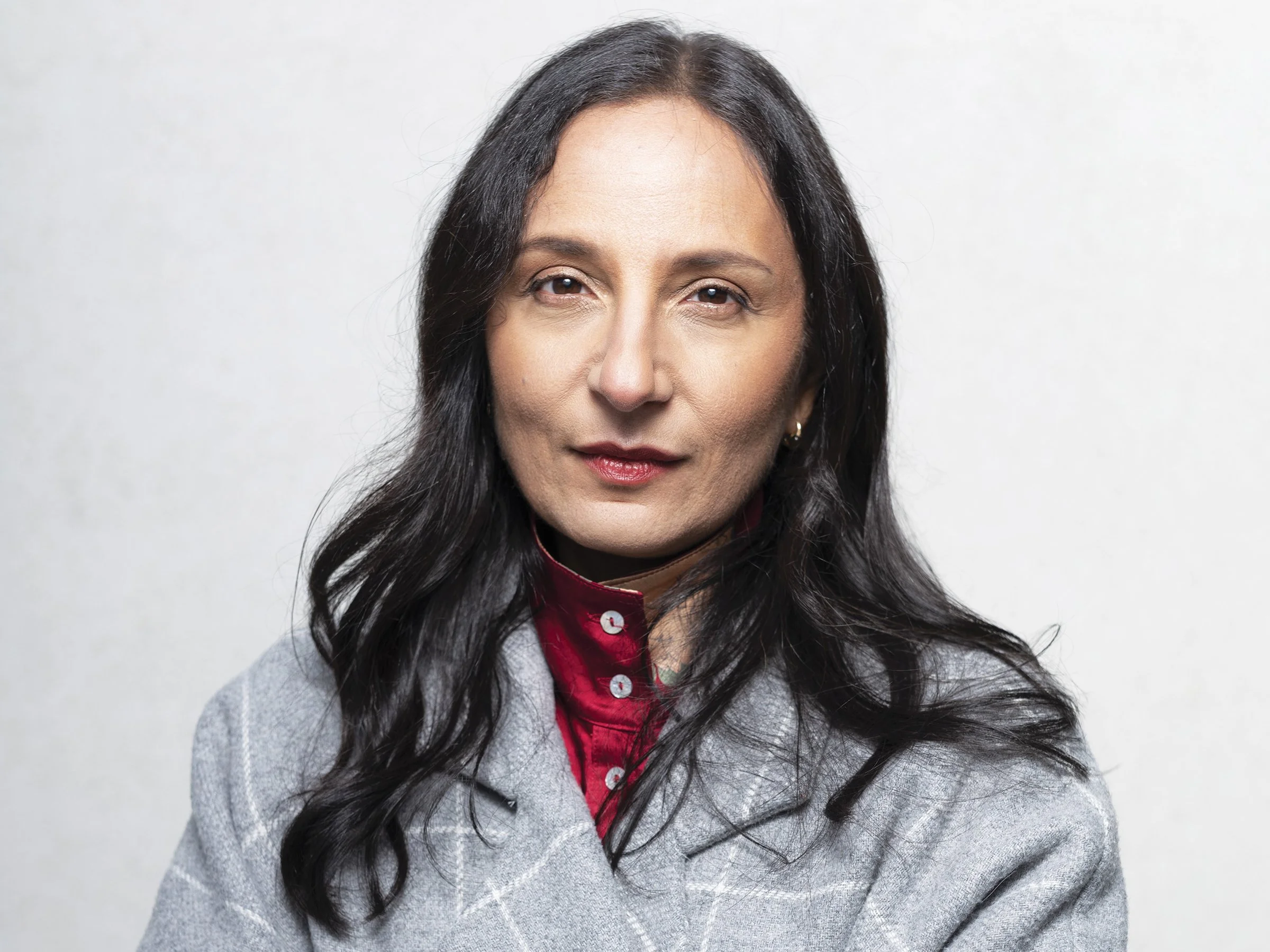
Madhur Anand, scientist, poet, author.
By SHAGORIKA EASWAR
Madhur Anand is a poet and professor of ecology and environmental sciences.
A poet and a scientist – those are not words one often sees together in one sentence.
“I can name one, Roald Hoffman, the Nobel-prize winning chemist, he’s a poet!” says Anand with a laugh. “I’d invited him to an interdisciplinary event I organized as Director of the Waterloo Institute for Complexity and Innovation. He said to me that poetry is the thing that means the most to him. And he’s won the Nobel! That’s the value of poetry to me. It’s just so precious. Though it can be a little hard to justify spending time on these pursuits when the earth needs saving.”
Anand’s poetry has appeared in literary magazines such as the Literary Review of Canada and The Walrus. Her first collection of poems, A New Index for Predicting Catastrophes was nominated for a Trillium Book Award for Poetry. The CBC named the book as one of ten all-time “trailblazing” Canadian poetry collections. Her second book of poetry, Parasitic Oscillations, was published to international acclaim. Her memoir This Red Line Goes Straight to Your Heart won the Governor General’s Award for English-language non-fiction.
And now she’s stepped into fiction with To Place a Rabbit (review on page 24), which is very dream-within-a-dream, book-within-a-book.
“It’s very apt to compare it to a dream, I wrote it during a period of jet lag!” she says. “I do think it comes from the subconscious, and you can’t really know your subconscious. I don’t approach my writing the same way I approach my scientific projects, the ideas sit in my mind for years. Like the translator meets the author at a literary festival, in a way, that’s how it happened to me as well. I did translate a real work from French into English.
“I realized that I’m not going to translate in the traditional sense, other ideas are coming out., the translator was becoming part of the story though the gist remains, the outside story remains.”
As a scientist and as a poet, she speaks different languages. “The language and culture of science are very different from the language and culture of basically everything else we do as humans!”
But the two are “totally entangled”. The language of science is her culture, part of her identity, how she thinks and behaves.
“Even if I didn’t use scientific words, you’d see it in how I write, the structure of how I write and the structure of science. Of course, I have the freedom in writing to use this word or that, and sometimes when a word from science arrives, I leave it in.”
Anand writes about the limiting factors in ecology – water, light, space, time. And how for the translator, it was not about finding the time but the “lag between this and that, here and there, now and then”.
That is how she truly feels as a writer, she says.
“People often ask me, ‘How do you find the time?’ I have a full research lab. I teach. I have three children. But they are stopping at the wrong limiting factor. Living organisms find a way to live. Writers find ways to write. It’s about remaining open to the idea, the space, the possibility. Figuring out how to open those lenses. The lag between our lived experiences and what’s possible.
“Science can be creative, but for the most part, the way society has positioned science leaves little room for discovery. As a scientist, being concerned with function and value can be a limiting factor in joy and creativity.”
As a scientist, Anand has been Canada Research Chair in Biocomplexity of the Environment at Laurentian University; and Canada Research Chair in Global Ecological Change at the University of Guelph. She has received the Ontario Premier’s Research Excellence Award, the Young Alumni Award of Merit from Western University, Ontario Distinguished Researcher Award, and Award of Excellence in Research and Technology Development.
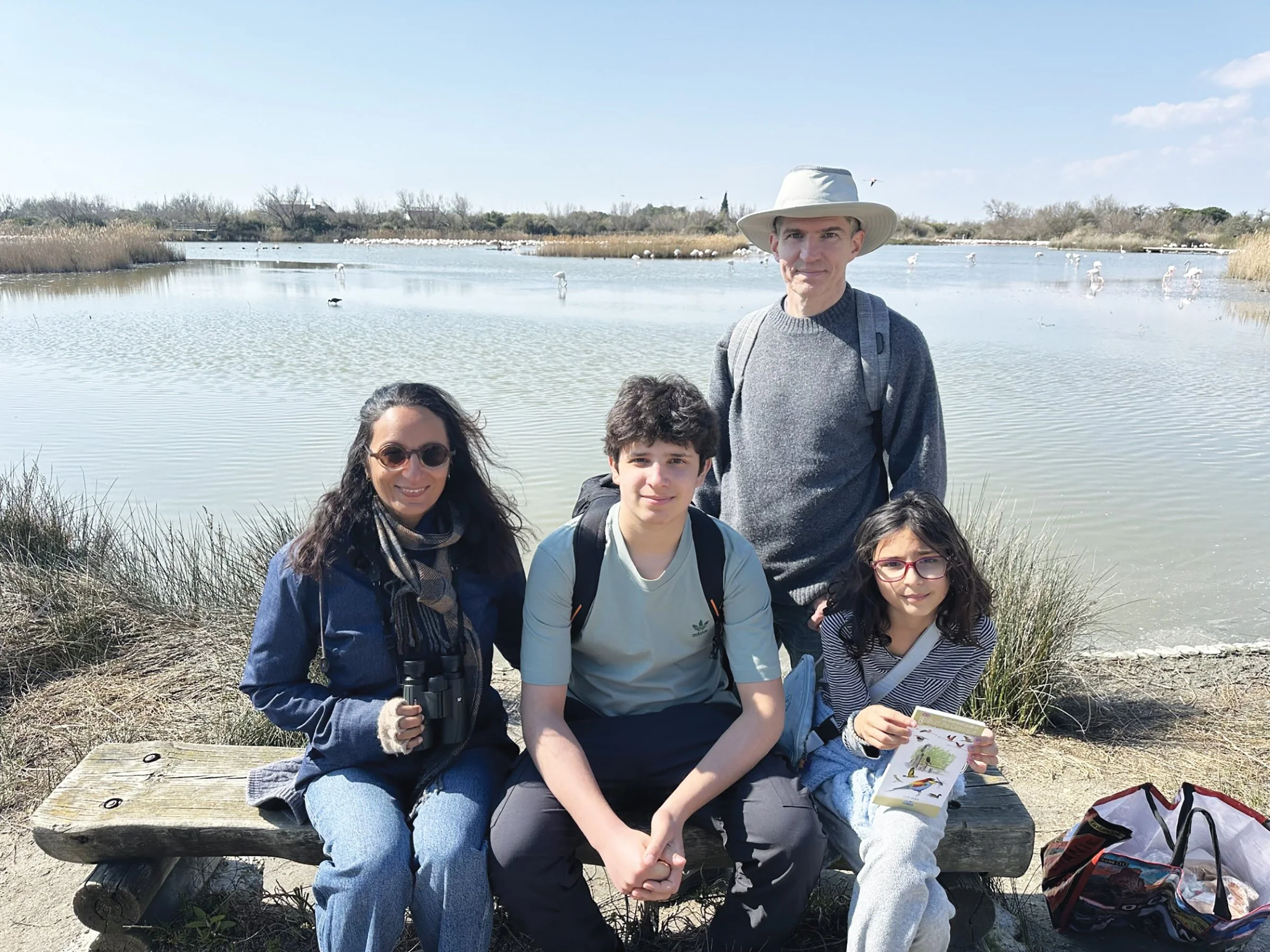
“Not internalizing rejection can be hard, but it is vital to success.” Madhur Anand on holiday with her family in the south of France.
She is a full professor in the School of Environmental Sciences at the University of Guelph where she leads the Global Ecological Change and Sustainability lab.
She has graduate and post-doctoral students and collaborators all over the world looking at ways to bring human behaviour and social dynamics into studies on biodiversity and climate change in coupled human environment systems.
Her research focuses on how the rapid pace and far-reaching potential of ecological change in the face of globalization and climate change is creating stress within ecosystems all over the world.
“We are trying to make quantitative models to operationalize that humans and nature are one whole and to what extent our behaviour and societal norms affect our environment,” explains Anand. “Bringing together social sciences and environmental sciences. There are things we can do to alter this trajectory. But we have to see societal change in order to see environmental change.”
We’re in a crisis situation, she says unequivocally, and change needs to happen at many scales.
“Scientists have consensus on the targets we need to meet and what we need to do to get there. We’re far behind, nationally and globally. Are we moving in the right direction? In some cases, yes. Hope is a very broad idea, but there’s no alternative to hope.
“But we must work very hard. Political changes and wars are viewed as larger problems but they are all related. Environmental problems are just as large – perhaps larger, because environmental changes are harder to reverse.
“We can connect it back to literature and art. These questions force one to have that lag, to think about what is possible. What direction can we take from here, what remains open. It opens up the mind and the spirit.”
Her father immigrated to Canada in 1967 from New Delhi and her mother, from Dehradun, followed in 1968.
“But of course, those were not their original homes. They had lived through the Partition, and left behind homes in what is Pakistan.”
Anand, who has detailed her family’s story in This Red Line Goes Straight to Your Heart says speaking about what drew them to Canada is like forcing a narrative after the fact. “I’d say it was a complex set of individual and psychological factors. I think he felt hope for a better life here, saw more possibilities.”
But everything was a challenge.
“He arrived with a small amount of cash and a cloth coat. In Montreal in the middle of winter. He borrowed a nickel to make a call from a phone booth. To the first Indian name he found in the directory. His ambition was to do his PhD in Physics, but McGill said their quota was full and pointed him to Concordia. He had to re-do his Master’s, much like what newcomers face today. And that’s another form of translation, isn’t it? Do it again in our language, our culture. He started a job as a high school teacher and they moved to a tiny mining town in Northern Ontario the very next day after my mother’s arrival in Canada.”
Anand was born in Thunder Bay and recalls seeing so much change as a second-generation immigrant.
“I wonder if every child feels a little different. I see my three kids and they are different from each other. But I also had reasons to feel different. Just entering Junior Kindergarten was like entering a foreign country, spending my entire day in a different language, a different culture. As a mathematician and a scientist, it was easy for my father to guide us. But the language side, the arts side, were just such a discovery for me. I saw it as a door, a portal to another future. Who was I? Who could I be?”
Her husband Chris is an applied mathematician.
Reflecting on her journey as a female scientist and as a person of colour, she says she achieved success because she worked as hard as she could.
“I have ambitions, I wanted things. It’s part of my own drive, part of my personality. My personal approach has always been that when I do things, I do them for myself at least as much, if not more, than to prove something to the world. I’ve wanted to prove to myself that I can do it. Science, art, being with family... can be generative in and of itself. I do it for the love of it. Otherwise I’m not sure if it’s worth it.
“But did I have to work harder? Probably yes. The only way I can prove it is not through my own story, the point of view of one, but through statistics. It’s well documented that inequities exist in what women can achieve in any realm. In the scientific world, in the literary world. There are still so few women who are full professors. Add women of colour and it’s an even smaller number.
“Society is learning, not wanting to accept the status quo so readily. So things are changing.”
Asked for tips on how to succeed by those who see a role model in her, Anand prefaces her response with these words:
“It’s difficult to tailor advice as no two humans have the same goal. In broad terms, what we need to do – and this applies to women in particular – is be your own boss. Not in terms of a business or a job but in your spirit. Whatever that means to you. There will be plenty of obstacles. A consequence of rejections is that people give up too soon. Don’t! I’ve had so much rejection.
“People only see the success. Don’t let criticism determine your path. Remain the boss of your spirit. If the criticism is constructive, take it and be grateful.
“If you can’t understand where the criticism is coming from or understand the reason, let it go, don’t try to make sense of it. Not internalizing rejection can be hard, but is vital to success.”
What’s next for her?
“I’ve got a couple of ideas – I’m keeping the possibilities open!”
• Grant’s is proud to present this series about people who are making a difference in the community. Represented by PMA Canada (www.pmacanada.com).