
A ROOM WITH A POINT OF VIEW
“IT’S HARD TO THINK OF DAVID AS NORMAL”
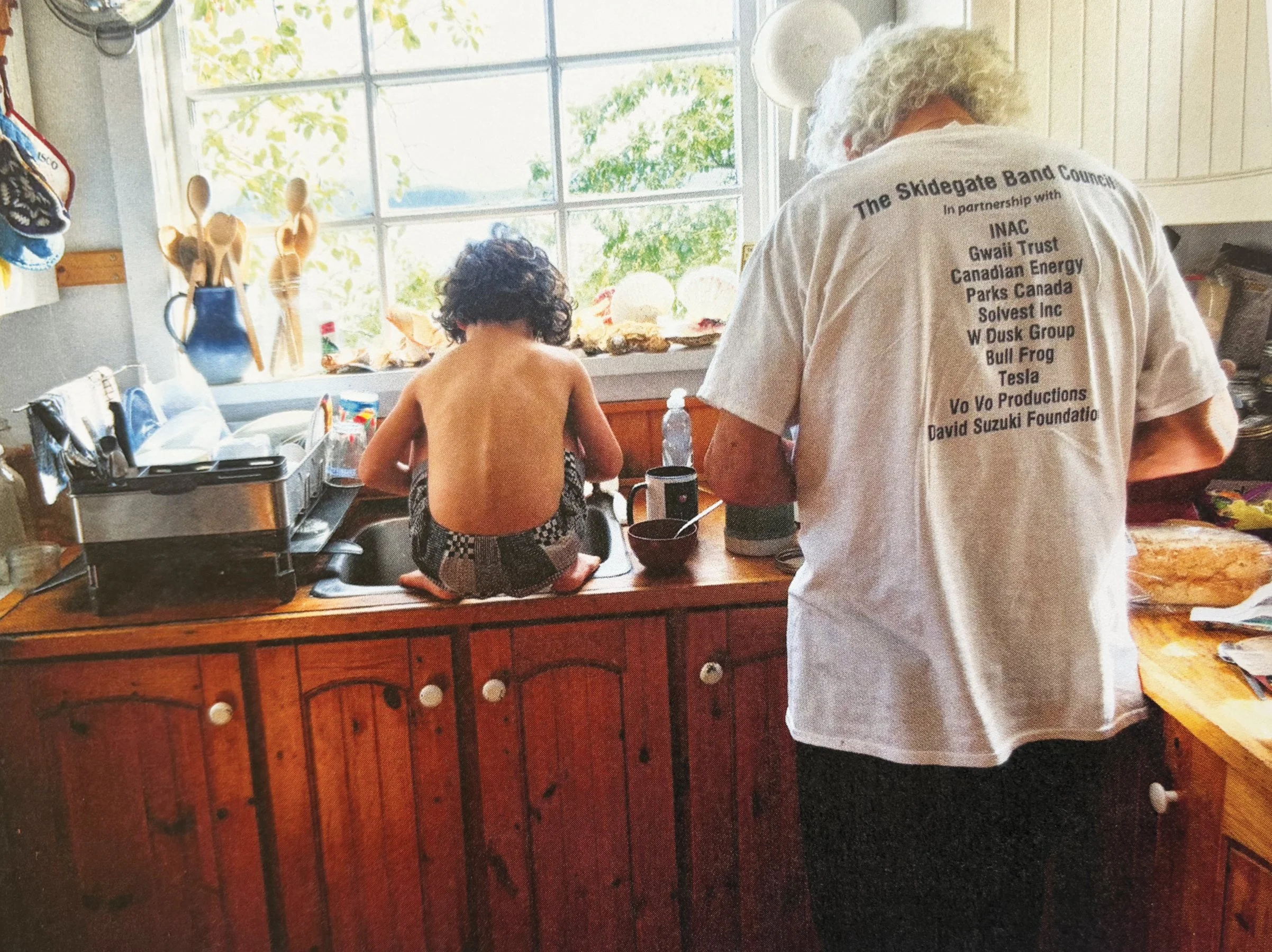
David Suzuki is sharing the love of washing dishes with his grandson Carr.
By SHAGORIKA EASWAR
The Legacy, published in 2010, and Letters to My Grandchildren, published in 2015, encapsulated so much wisdom that I continue to dip into them periodically, and have recommended them to friends and family over the years.
Lessons From a Lifetime, written with senior writer and editor at the David Suzuki Foundation Ian Hanington, who has also co-authored Everything Under the Sun and Just Cool It! with Suzuki, is the definitive celebration of David Suzuki at ninety, of how one man’s courage inspired generations of environmental activists.
Celebrating the environmental icon’s remarkable ninety years on planet Earth, this vibrantly illustrated book captures the essence of a revolutionary life.
From surviving internment camps as a Japanese Canadian child to becoming North America’s most trusted voice in science communication, Suzuki’s journey pulses with ingenuity, courage, and conviction. Suzuki’s own words – along with intimate photographs and personal stories from family, colleagues, and celebrity admirers – reveal the passionate man behind the public persona.
It’s a stunning tribute to a fearless truth teller who transformed how we understand our relationship with the natural world.
Many of us are aware of David Suzuki’s phenomenal body of work. The book is an opportunity to meet the man behind the legend.
The story begins with the chapter with the title My Happy Childhood in Racist British Columbia in which he shares how his family was sent to the internment camps during World War II even though his grandparents had left Japan in 1902 and 1904 and both his parents were born in Canada.
I never learned to speak Japanese, so I was bullied by some children. It took a long time to overcome my mistrust and resentment of Japanese Canadians because of the way I was treated in those camps.
In a sharp reminder of how we internalize racism:
Ignorance and the relentless propaganda during the war, portraying buck-toothed, slant-eyed “Japs” in the cockpit of a plane on a kamikaze mission, must have caused mystery and fear just as today’s image of a Muslim extremist strapped with explosives. Every time I looked in a mirror, I saw that stereotype. I still don’t like the way I look on television and don’t like watching myself on my own TV programs.
In College and a Burgeoning Career, a commentary on the supports that exist – or not – for scientific research in the country.
Describing a grant he received in 1962 from the National Research Council in Ottawa – $4,200 when his American peers were getting $60,000 to $80,000 – he writes that “Canada had not moved into the post-Sputnik era, as the US had, with a huge commitment to science as part of the Cold War competition.”
In Adelaide, Lewis O’Brien, a respected elder of the Kaurna People, names him Karnemeyu, meaning holy mountain.
Of all the names he has received from Indigenous People, three have meant mountain.
Suzuki shares, as he has innumerable times before in his books and in his columns, learnings from the Indigenous communities.
“The Haida people do not think they end at their skin or fingertips. Guujaaw opened for me a window into a radically different was of seeing the world.”
And then there’s a quote on Suzuki from Guujaaw, artist, singer, hereditary leader and former president, Haida Nation:
“It’s hard to think of David as normal, having a household name, the familiar voice from many a generation’s childhood and the fearless face we all know so well... none of that would be associated with ‘normal’.
“...Our David is foremost a husband, dad, and gampa. He loves his family, good food, and he swears. That’s who he is, not just the golden-voiced orator. We are lucky to have David in the world with us.”
Australian politician, physician, environmental human rights activist Bob Brown recalls the time Suzuki addressed the National Press Club in Canberra in 2006. He warned, “in graphic fashion” of the environmental disasters associated with the (then) nascent Atlantic salmon farming industry.
Before his speech, the luncheon was served: grilled Atlantic salmon. The guest of honour had it sent back to the kitchen and gave his speech on an empty stomach!
His superstar status sits uncomfortably on Suzuki.
“I have never sought or desired celebrity, but television provides a kind of intimacy that movies do not. So when people run into me, they often greet me as a familiar friend. I can’t help being startled each time someone addresses me, though almost always it is to say something kind. I must admit I am not able to respond generously because greetings are still a surprise and intrusion, and my teenage reticence to engage in conversation returns.”
But he has a host of super-celebrity fans. Margaret Atwood, Jane Fonda, Al Gore, and Wade Davis, to name just a few.
Justin Trudeau had this to say: “I have known David for decades now, and for me he has been a teacher, an inspiration, and a friend but also a critic, an antagonist, and a royal pain in the ass. And I have relished every single moment of it...”
And Suzuki made it to the top ten on the list of the Greatest Canadian, a search launched by CBC in 2004.
There are chapters on his first wife, Joanne, and their children together, his present wife Tara and their children; and also on their grandchildren.
On their achievements, and on how he worried, like any other dad, about the effects of celebrity culture on his children. After his daughter Severn addressed the Earth Summit in Rio de Janeiro in 1992, Al Gore came up to her and told her it was the best speech at the event.
It was all heady stuff for a twelve-year-old, and I began to worry about what this would do to her sense of herself. I stopped worrying the next year when she was invited to appear on The Joan Rivers Show in New York. “Dad,” Sev told me, “I hope it’s okay, but I’m not going to do this. I have to study, and I want to make the basketball team.” She had her priorities right.
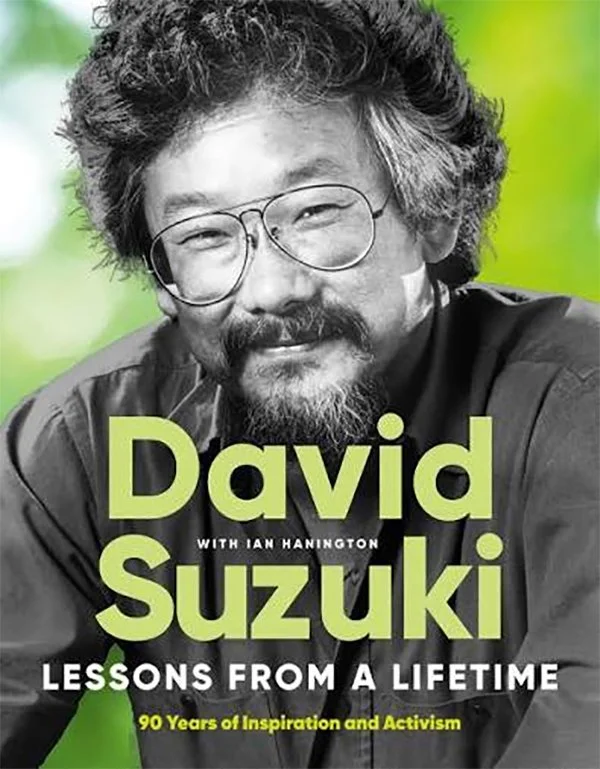
Lessons From a Lifetime by David Suzuki with Ian Hanington is published by Greystone, Books, $40.
Reflecting on his life’s achievements, Suzuki writes that perhaps one or two of the programs he’s done on radio or television might be played on his passing, or books he’s written might be re-read.
“That would be nice. But the one true legacy of any value is my children, and through them, my grand-children...my grandchildren are my stake in the near future, and it is my most fervent hope that they might say one day, ‘Grandpa was part of a great movement that helped turn things around for us’. I also hope that they might remember my most valuable lesson and be able to say, ‘Grandpa taught us how to catch and clean a fish. Let’s go catch one for dinner’.”
Aww.
A sublime read at so many levels.