
A ROOM WITH A POINT OF VIEW
HAPPY NEW YOU!

“Despite everything we believe about ourselves, we often go along with things even when we know we shouldn’t, in situations both life-threatening and trivial”. Image credit: PARHAM BARATI on Unsplash.
By SHAGORIKA EASWAR
Dr Sunita Sah begins her book with a quote from novelist and chemist C P Snow: When you think of the long and gloomy history of man, you will find more hideous crimes have been committed in the name of obedience than have ever been committed in the name of rebellion.
She goes on to list a multitude of them. Ones that we know of, the ones that come immediately to mind. And equally horrifying but lesser known ones that perhaps only scientists know of.
From the killing of George Floyd by a police officer while two other police officers went along to the infamous studies conducted by social psychologist Stanley Milgram who wanted to know if the constant Nazi refrain, “I was just following orders,” was a psychological reality.
From the NASA scientists who recommended that the launch of the ill-fated Challenger be postponed – and were overruled – to Rosa Parks who didn’t give up her seat on the bus because of the simple reason that she was tired of giving in. Or Jeffrey Wigand, whose act of defiance against the tobacco industry was made into the movie The Insider, starring Russell Crowe.
She’d like to think that she’d have protested in such situations, said Stop, writes Dr Sah. But having studied defiance and authority for years and from personal experience she knows that “despite everything we believe about ourselves, we often go along with things even when we know we shouldn’t, in situations both life-threatening and trivial”.
Like the time she went along with a doctor’s decision that she needed a CT scan, even though as a doctor herself, she knew she didn’t. Because in that interaction, the other doctor was in a position of authority over Dr Sah, the patient.
Some level of compliance is necessary, she writes – it allows us to cooperate with one another, to live in harmony. But one has to re-evaluate when every action is a result of the lessons ingrained in us as children. We develop an ingrained resistance to resistance.
Dr Sah describes a childhood when she was encouraged to be good because her very name, Sunita, means “she who has good conduct or behaviour”. But she also shares goosebump-raising instances of when her mild-mannered parents stood up to bullying and injustice.
Her upbringing gave her a master class in compliance, she writes, but as she grew older, she realized that defiance is not merely one state, it’s a process, a gradation of understanding, questioning and action.
She covers something we hear often, gut reaction. “When your ‘gut’ speaks to you, it could be expert intuition – but it could also be your biases. Being able to distinguish between the two is critical.
It is equally important to know that consent is different from compliance. Consent represents what Dr Sah describes as our True Yes.
Different from smiling in a harassing situation. Like this instance she shares:
A colleague once referred to my “crocodile smile” that I display when put in situations where I am not comfortable complying but feel I have little choice – such as being expected to perform the role of secretary at a meeting yet again, or come into to work over the weekend yet again, or politely answer my boss’s questions about my “exotic race” yet again.
Dr Sah breaks down and presents the seemingly simple act of saying Yes into five elements of consent – a person’s capacity, knowledge, understanding, freedom, and authorization to make a decision. And underscores the value of pausing, of not saying yes or no right away. To create a psychological distance from the situation. One of the simplest ways to do this is to talk to yourself, even silently, she advises. “As though you were a trusted friend, a mentor, or even just another version of yourself”.
She illustrates the power of defiance with examples of familiar names, though we may not be as familiar with elements of their journeys.
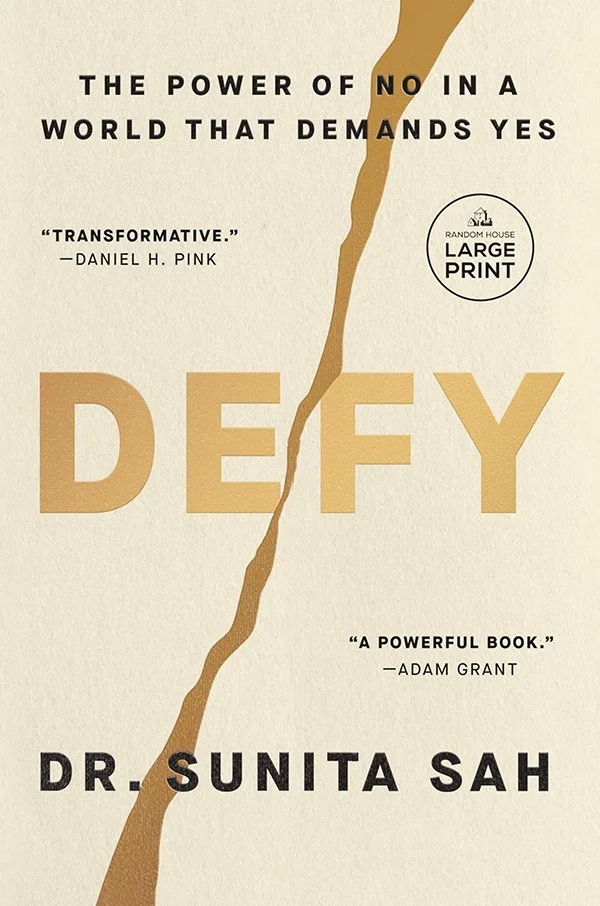
Defy by Dr Sunita Sah is published by One World, $39.99.
Mindy Kaling, on how she succeeded in television and comedy writing, two industries dominated by men: Her parents raised her “with the entitlement of a tall, blond, white man”.
Natalie Portman: “If a man says a woman is crazy or difficult, ask him, ‘What bad thing did you do to her?’ That’s a code word. He’s trying to discredit her reputation.”
Defiance means acting in accordance with your true values when there is pressure to do otherwise. And it is in us to make the right decision in countless instances – not always revolutionary ones, but minor defiances that have an impact.
Maybe it’s a teenager refusing to participate in playground bullying.
Maybe it’s the only female attorney in the firm declining to take on more work than her male peers.
Maybe it’s a young person challenging a family member for making a bigoted remark at the dinner table.
For those of us waiting for the “right moment”, Dr Sah has this:
The time to defy does not need to be perfectly right; it just needs to be right enough, safe enough, or effective enough. Otherwise we can always find an “out”.