
GRANT'S DESI ACHIEVER
“WE’RE NOT JUST THE GENES WE ARE BORN WITH”

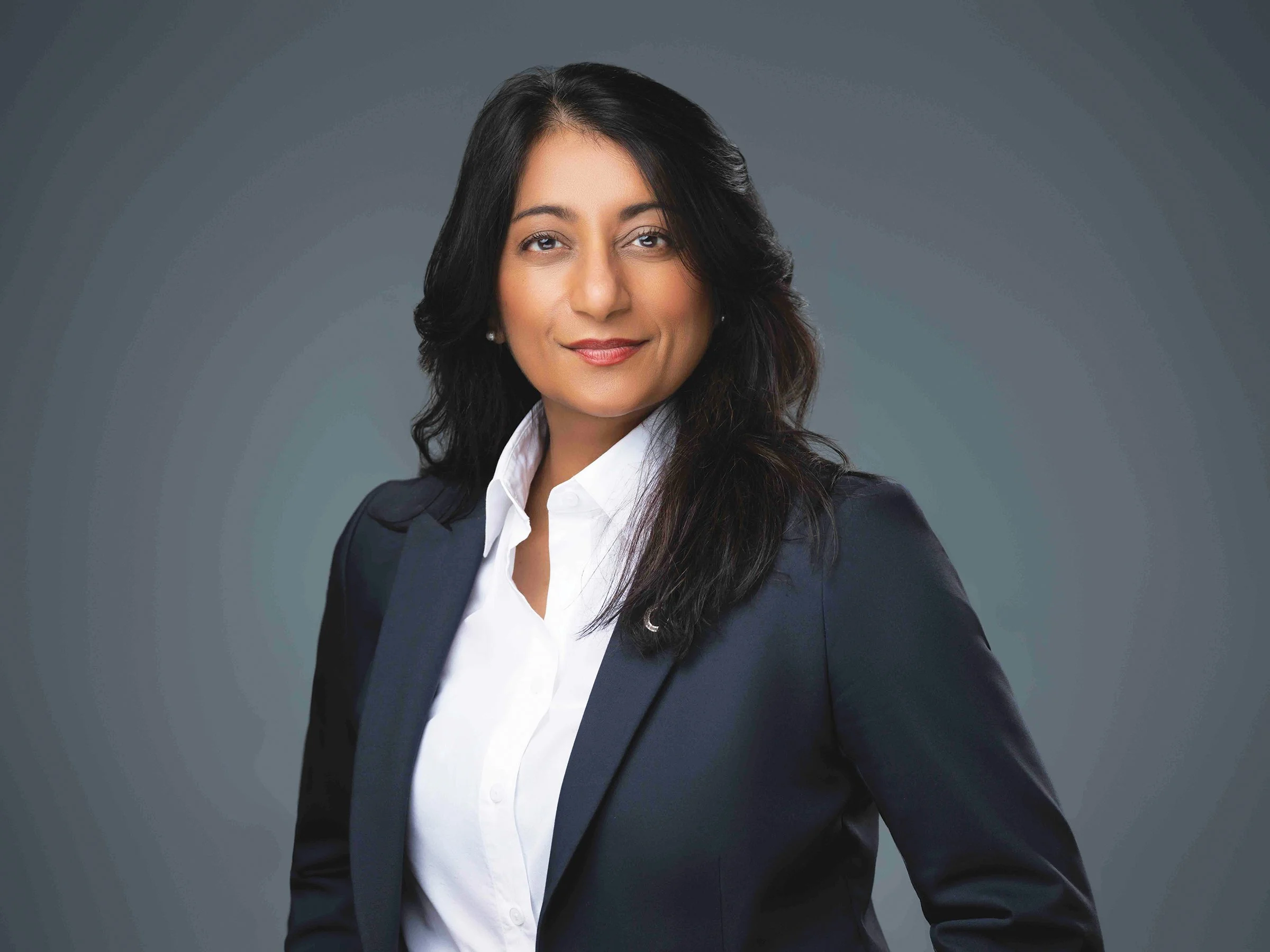
Prof Natasha Rajah, Canada Research Chair in in Sex, Gender and Diversity in Brain Health, Memory and Aging.
By SHAGORIKA EASWAR
Professor M. Natasha Rajah lays to rest a doubt many of us have harboured, a question that we ask only partly in jest: Are men’s brains different from women’s brains?
The short answer? No.
“But it’s a huge question. There’s a lot of debate about this. The structure and volume are both equally distributed for male and female brains. Male brains are bigger because of bigger bodies. There are certain differences, but it’s hard to say whether that’s due to biology or due to different experiences. How society interacts with us. What we’re reading – girls tend to start earlier and develop stronger language skills, while spatial skills are stronger in boys. It’s hard to disentangle whether that’s because of gender, our social, cultural experiences, or due to sex, which is chromosomal.
“It’s true that a lot of biomedical research and clinical trials were often based on men, but sex differences in the brain have been studied for decades. One aspect that’s not been studied in any detail is how sex affects brain health. And we’re hearing about it quite a bit as brain health is having a moment right now.”
Prof Rajah is a Full Professor in the Department of Psychology, Toronto Metropolitan University (TMU) and Tier 1 Canada Research Chair in Sex, Gender and Diversity in Brain Health, Memory and Aging.
“Historically, sex has not been studied in the cognitive neuroscience of ageing because both male and female brains show a decline with ageing. People haven’t thought to look under the hood – are the reasons for age-related mental decline the same? As a woman ages, the effects are stronger. Again, is it because of sex or gender? The way we interpret things, the way males and females approach a memory task differs. We use different strategies, so we interpret differently.
“Adding diversity to this mix, we study the social determinants of health. Ethnicity, education and lifestyle, stressful life events, gender-specific experiences of violence, all have an impact on brain health.”
Similarly, addictions affect brain health, including mental health and how we age. The mechanisms for addictions, suicidal ideation or depression might be different, but the environmental factors that overlay on top might be similar.
Mental health disorders are related to differences in prefrontal function of the brain, says Prof Rajah. As is ageing. Implications for both include the ability to plan, organize, and our behaviour.
But how do they differ in males and females?
“We have to disentangle and understand what is different and what is common,” she says. “Which treatments are common and which are specific to a condition. Diet, exercise, good quality sleep, they all have benefits for ageing and mental health. We call these modifiable risk factors, and the ones for dementia are similar to ones for mental health.
“Quitting smoking, for instance, and drinking within safety guidelines are good for both brain health and heart health. Our degree of social connectedness has an impact and that can vary with culture.”
Dr Rajah’s research encompasses how biological sex and sociocultural gender affect brain ageing and Alzheimer’s risk.
“I study how sex, gender and sex-specific experiences like menopause affect brain health. How vascular health factors and immune response are related to brain health. Women have a stronger immune response because of our reproductive role – and a higher rate of auto-immune disease. Two-thirds of auto-immune disease cases are women. We used to think that it’s because women live longer but now know of other risk factors. We are studying what might be triggering these diseases.
“Research identifies predictors of lower cognitive abilities and ageing and found that social justice factors come into play. Negative social determinants of health such as poverty, lower quality food, lower education.”
She describes something called the cognitive reserve. The idea that life experiences that are positive – education being one – help mitigate effect on cognition, .
Alzheimer’s disease is a devastating, currently incurable brain disorder that disproportionately affects women – nearly two-thirds of Canadians aged 65 and older living with dementia are female, according to a 2023 report from Public Health Canada. The disease can begin silently decades before symptoms appear, often in midlife.
“Someone could have a level of neurodegeneration, but with higher education, are able to perform better in verbal memory tests. They are not trying to mask the condition, they are just stronger in this. So the upside is that women, with stronger verbal skills maintain a higher quality of life, but they are also diagnosed later and then show a steeper decline.”
Her team is working to develop tests that are not verbal to catch cognitive decline earlier.
Some memory decline occurs during menopause and women are familiar with the term “brain fog”. But is it temporary or is it pathological? Will it continue?
To explore if we could detect and even prevent Alzheimer’s before it starts, Prof Rajah launched the Brain Health at Midlife and Menopause (BHAMM) Study in 2017. Supported by a broad network of collaborators, BHAMM is one of the first large-scale studies to investigate how biological sex, menopause and social factors interact to shape brain ageing.
“We are realizing in the neuroscience field that the brain doesn’t function in isolation, we don’t live in isolation. Kidney health affects brain health, liver health affects brain health. We need the structural history of a person – where you come from, the stresses related to say, immigration, or language barriers. The sociological affects the biological. The brain is affected by the body. We’re not just the genes we are born with.”
“Know the system you are working in. And don’t be shy to ask for help – people don’t know you need help otherwise.”
To detect subtle cognitive changes in the brain often missed by standard MRI tools, her team uses a novel functional MRI (fMRI) that targets areas like the hippocampus, which are among the first areas affected by Alzheimer’s.
“We have shown that task-fMRI allows us to identify memory-specific alterations in brain health that directly correlate with memory performance,” says Prof Rajah.
Born in Sri Lanka to a Hindu mother and a Burgher father of Tamil-Portuguese descent, she lost her father at a very young age. Her mother moved to Zambia when she was four, and to Canada when she was six. The family settled in the Rexdale area of Etobicoke.
“It was challenging, for sure,” Prof Rajah recalls. “We were in a lower to mid socio status. My mother was raising three daughters as a single mom. She had to go back to school to get a diploma to get a job. She had to learn to drive. As the youngest of my siblings, I had it the easiest. I had my friends, simple toys. And we were happy. At school, there were very few South Asians, but I didn’t notice it that much. Mom had family members here and that is a critical strength. They were really there for each other, so there wasn’t as much loneliness. I had many cousins.
“Later in life, I became aware of certain things, there’s a sensitivity that’s very aware of exclusion that develops. You know when you are excluded, you’re primed to spot it, but growing up, I didn’t feel othered. Everyone else was also very welcoming. We had strong family connections and grew strong roots, we were resilient.””
Prof Rajah was drawn to her field in her undergrad year at UofT.
“My psychology course, I fell in love with it. It just made sense. I didn’t feel I was studying when I was reading course material. Even to this day, I don’t feel I’m working when doing research. It’s something I want to do. I was lucky I was able to pursue a career in it.”
She describes herself as very fortunate that as a female scientist, and as a person of colour, she faced fewer obstacles than one might imagine.
“I was the only brown woman in my program, but I didn’t notice it. It wasn’t a thing. Might also be a reflection of my personality type! Maybe because of the tragedies that occurred earlier in life, I gained a different perspective. What’s a problem and what’s a real problem? Is this worth putting mental energy in? It’s a testament to the university, the program and my mentors – I had some great mentors. My Ph.D. supervisor, Dr. A. R. McIntosh, in particular, was hugely supportive. I had a chemistry teacher who said, ‘Just do the right thing, do your work, and you will rise’. I also had great female mentors and that is so important. One said to keep doing the science. And that’s what I do.
“Of course, I notice things as an older woman. The glass ceiling, who is being heard. It’s tough. My husband hears it when I go through a day like that! But really, it’s about remembering that the degree may differ, but everyone faces challenges. What’s important is what can I learn from this?
Her husband is a businessman and their 12-year-old daughter is a constant source of joy.
“She’s amazing! She makes us laugh,” says the fond mother.
Asked if her daughter thinks what her mother does is cool, Prof Rajah laughs out loud. “You would think? But mother-daughter dynamics are different. She says she will never be a scientist!”
To those who seek her guidance on how to succeed in Canada, she underscores the importance of knowing the system they are working in.
“I wish I had had someone to guide me. No one in my family did their PhD in Canada. I didn’t know that you need to connect with your teachers in high school about the best post-secondary options for you. There’s what we call a ‘hidden curriculum’. How to address someone in an email. When to email someone. How would you know all this unless someone showed you the way? Establish a mentor network.
“And don’t be shy to ask for help. People don’t know you need help otherwise.”
Prof Rajah finds conducting research with her students very rewarding.
“Seeing results with them and the feeling that you have just discovered something no one else has seen before, that’s as thrilling as the result of the first tests I conducted.
“That, and seeing my students go on to have successful careers, start a family... When I get a Christmas-New Year’s card from them, it’s a reflection of a relationship formed. We both mattered to each other.”
• Grant’s is proud to present this series about people who are making a difference in the community. Represented by PMA Canada (www.pmacanada.com).