
SPOTLIGHT
THE SUN IS SHINING AND SO ARE THE MUSICAL STARS
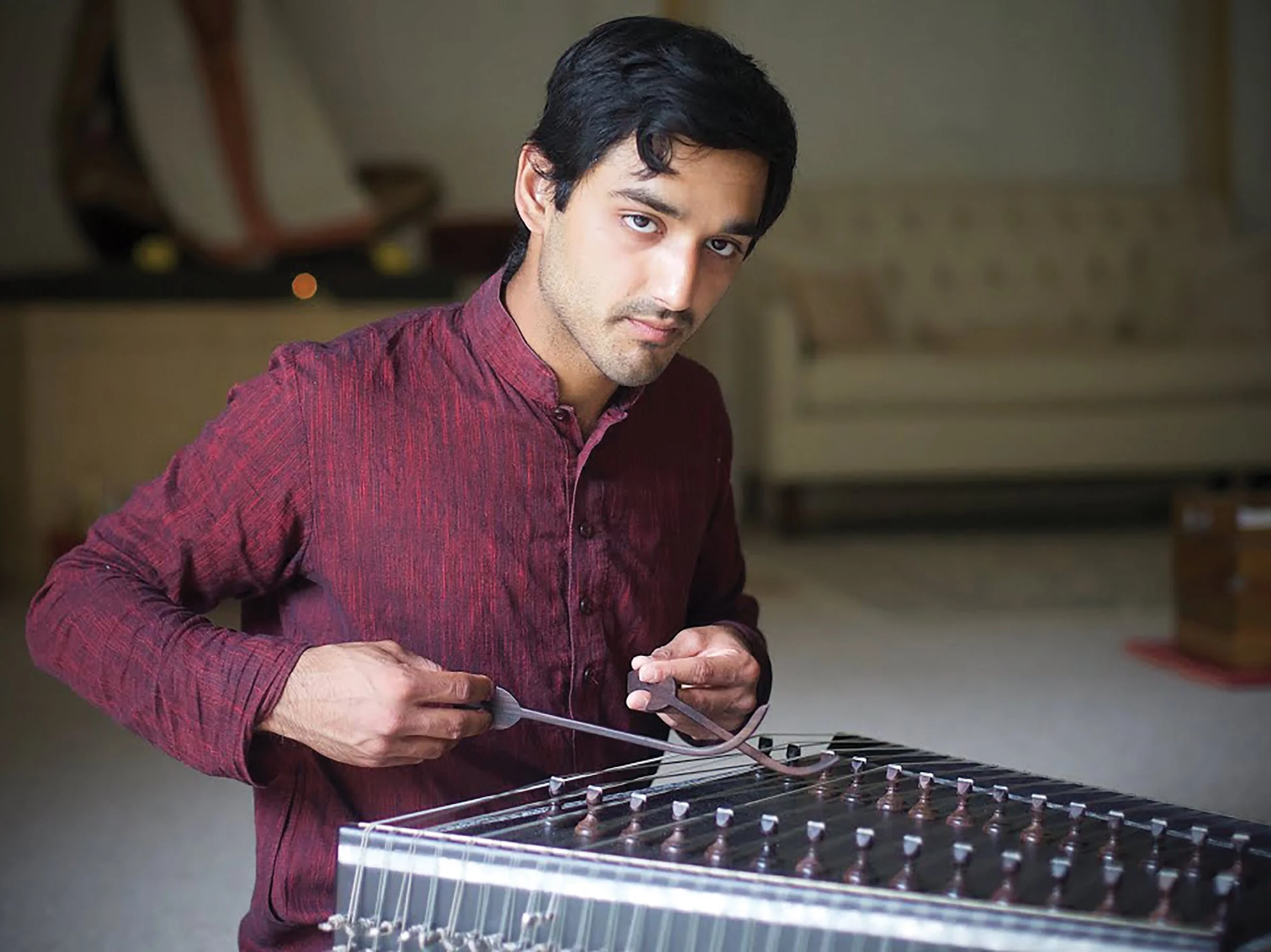
Vinay Desai on santoor.
By MOHAMED KHAKI
Among the nine “rasas” – literally “essences” or “flavours” – in raag music, the Sringara rasa evokes sensual beauty, tenderness, adornment, longing, separation: all the emotions associated with love and romance.
I was reminded of Sringara rasa (or perhaps Adbhuta – the rasa of wonder) during a recent conversation with santoor player Vinay Desai. Describing the first time he heard santoor maestro Pandit Shivkumar Sharma in concert while attending university in Delaware in 2006, he told me quietly, “It felt unlike any music I had heard before”. Then he added, “I immediately felt that I needed to learn from Pandit ji.”
Clearly, I was speaking with someone who had been struck by the beauty of raag music. To me, this was Sringara and Adbhuta rasas working their magic on a fertile mind.
Most of us can relate to the entrancing power of music, particularly during a live performance, and to the fantasy of being able to play like the artiste before us. Some of us may even be moved enough to take music lessons while pursuing a career “with more prospects” – which for many first-generation immigrants means choosing economic stability over artistic risk.
It is rare, however, to encounter someone like Desai, who, after completing the requirements to begin studies in both Pharmaceutical Science and Law, had the chutzpah to travel to Mumbai for six months and ask his idol to accept him as a student. Pandit ji advised him first to train under two of his senior disciples, Takahiro Arai and Kunal Gunjal.
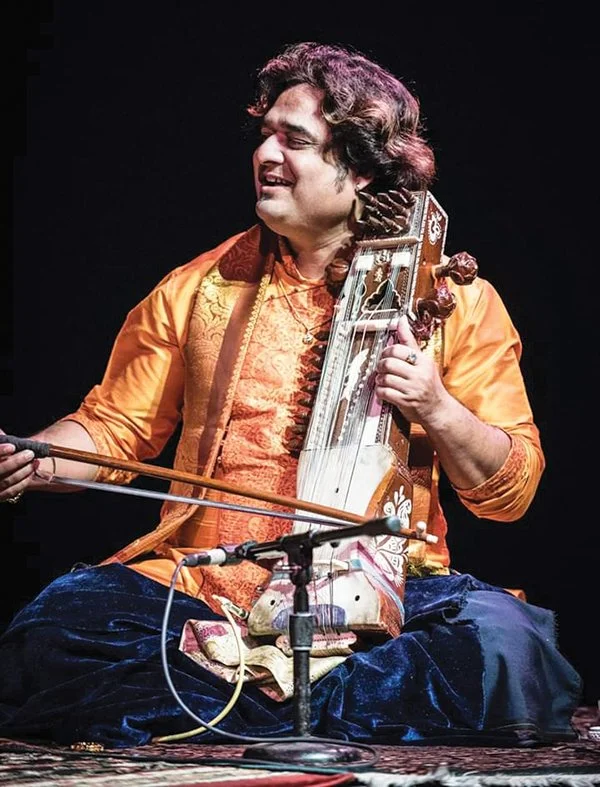
Pankaj Mishra on sarangi.
Impressed by Desai’s commitment – and by the progress he made while simultaneously holding down a job in the United States – Pandit ji eventually accepted him as a disciple when Desai made what he describes as a “second leap of faith” and returned to Mumbai a few years later.
Today, Desai is an accomplished performer who teaches and performs regularly across the United States. His international appearances have also taken him to India, Australia, Argentina, and Canada. Most recently, he performed in Toronto at Hammered! International Festival of Dulcimers at the Nanji Family Foundation Auditorium at the Aga Khan Museum.
Desai returns to the same venue in June, this time alongside Toronto-based sarangi exponent Pandit Pankaj Mishra and tabla prodigy Vivek Pandya, a disciple of the renowned tabla maestro Pandit Anindo Chatterjee.
The program will feature individual presentations by Mishra and Desai, followed by a sarangi-santoor jugalbandi.
Born in Long Island, New York, Vivek Pandya has already established himself as a dynamic – indeed vivacious – accompanist, and will perform on all three segments of the evening.
Mishra is an “A Grade” artiste – a prestigious accreditation conferred by All India Radio and Doordarshan – who has performed extensively in India and abroad, both as a soloist and accompanist. In the latter role, he has accompanied leading vocalists – the sarangi being preferred over the harmonium by many connoisseurs – and is also in great demand as a lehra accompanist for senior tabla maestros such as Pandit Swapan Chaudhuri, Pandit Kumar Bose, and Pandit Anindo Chatterjee. For those whose curiosity is piqued, there is a lovely YouTube recording of Mishra providing lehra for a tabla jugalbandi by Kumar ji and Anindo ji at a 2019 concert in Austin, Texas.
Even while remaining deeply rooted in the traditions of raag music, Mishra has explored widely across musical forms, particularly since settling permanently in Canada with his family in 2020. He was a contributor to Immersed, bassist and composer Justin Gray’s spatial-audio album, which earlier this year won the Grammy Awards for Best Immersive Audio Album.
Interestingly, Gray – who teaches at Humber Polytechnic – has studied raag music with Kolkata-based Pandit Shantanu Bhattacharyya, alongside fellow musicians Jonathan Kay and Andrew Kay, both of whom are also featured on Immersed.
While writing this article, I found myself recalling an unforgettable scene from Amadeus by Peter Shaffer, which I saw at Toronto’s Royal Alexandra Theatre in 1981. Directed by the legendary Peter Hall, the production arrived in Toronto with much of its Broadway cast intact.
Already celebrated as one of the finest Shakespearean actors of his generation, Ian McKellen, playing the court composer Salieri, speaks of his dawning realization that the vulgar, immature Mozart is nevertheless a divinely inspired genius.
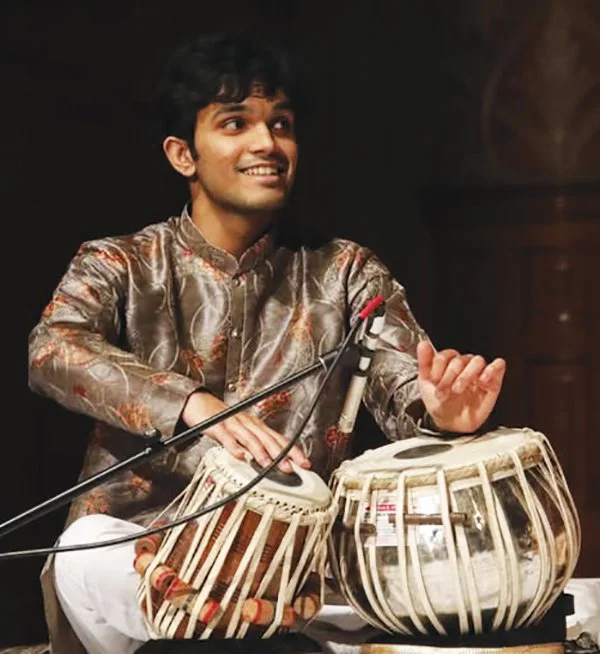
Vivek Pandya on tabla.
I remembered that scene giving me goosebumps in 1981 when Desai told me, “When I first heard Shivkumar Sharma ji, I felt that I had never before heard such beautiful music.”
Alone on stage, as Salieri delivers his celebrated soliloquy on Mozart’s Serenade for 13 Winds, the audience experiences the overwhelming beauty of music as it reverberates through Salieri’s memory.
In my view, every raag in the Indian classical tradition possesses this beauty and power to inspire wonderment – I am convinced that Toronto audience will be awed by Desai, Mishra and Pandey, three artistes making their mark in this majestic tradition.
• Mohamed Khaki is the Programming Director at Raag-Mala Toronto.
When and where: Saturday, June 13, 7:30 pm at Nanji Family Foundation Auditorium, Aga Khan Museum, 77 Wynford Drive. Details and tickets: www.agakhanmuseum.org.