
A ROOM WITH A POINT OF VIEW
A PAIN-FREE LIFE. IMAGINE THAT!

Even though it commands the processes that create and recognize pain throughout the body, the brain doesn’t itself experience pain. It ‘remembers’ the pain long after physical damage has healed. Image credit: RAKESH MEENA on Unsplash.
By SHAGORIKA EASWAR
Dr Sanjay Gupta, known as “America’s favourite neurosurgeon” takes pain seriously.
“Having parents who live a pain-free life is the gift I aim to give you, so that your mother and I may always be present, active, and engaged,” he writes to his daughters in It Doesn’t Have to Hurt.
He begins by describing various types and categories of pain, and how it affects different people differently. What causes it, what may best relieve it.
He shares a joke: Ask ten neurologists “What is pain?” and you will get eleven different answers.
And a remarkable fact. Even though it commands the processes that create and recognize pain throughout the body, the brain doesn’t itself experience pain. But “for reasons not yet fully understood, the brain ‘remembers’ the pain long after physical damage has healed. And what the brain cannot forget, the body remembers.”
Memory starts with attention, Dr Gupta writes. And so, “simply focusing your attention toward or away from pain is critically important for changing how you experience it”.
He cites the theory that chronic pain is essentially a learned behaviour in which the brain encodes an initial acute pain experience, then plays it over and over again even when no physical threat exists.
He quotes one of the world’s foremost pain scientists, A. Vania Apkarian, who describes chronic pain as “a memory that cannot be extinguished”.
One message that stands out loud and clear is that “Pain is an incredibly elaborate biological process, but it is also mostly a product of the mind”.
It’s why a child may not cry out in pain until he sees the look of concern on a parent’s face, writes Dr Gupta. He’s looking to a trusted source to interpret the significance of the sensation. I am reminded of the time I slashed my foot on a broken glass bottle while playing in a park as a little girl. I hobbled home, dripping blood all the way, but in no panic. My mother opened the door, and looked down at my foot – one look at her expression and I was bawling.
But Pain Reprocessing Therapy might be able to retrain the brain, writes Dr Gupta. “The goal of the technique is not about developing skills to cope with pain or manage it, but rather to eliminate it altogether by retraining the brain,”
He shares the personal pain journeys of his mother and his wife.
He cites countless studies and the work of eminent physicians. Among them:
Canadian physician William Osler who instructed his students to “listen to the patient. Quite often he is telling you the diagnosis”.
Sean Mackey, director of the Systems Neuroscience and Pain Lab at Stanford, who says pain is both a physical and psychological phenomenon.
Prasad Shirvalkar whose team mapped signals of chronic pain for the first time in history in 2023.
Former US Surgeon General Vivek Murthy who calls the crisis of loneliness and isolation “one of our generation’s greatest challenges’.
Loneliness predicts long-term physical health consequences, Dr Gupta points out.
He describes inequities in the system. Minority women were 52 per cent less likely than non-minority men to have surgery offered as a treatment option. He’s referencing studies conducted in the US, but time and time again the issue rears its head in discussions with medical professionals in Canada.
And then there’s this, more wide-ranging. According to a review covering seventy-eight studies, of young adults who experience chronic pain, one of the most consistent factors is simply being female.
Dr Gupta also covers the role of personal and culture-based practices like yoga, meditation, massage therapy, acupuncture, guided imagery/progressive muscle relaxation, chiropractic care and naturopathy in pain management. With more and more research being conducted in these, they are seeing wider acceptance among western medical professionals. He makes the link between the popular trend of forest bathing with the ancient Indian concept of Vanaprastha. While everyone can’t dash off to the jungle for a good number of years, the benefits of being surrounded by greenery are well-documented. Cue the study on using green light therapy for pain management.
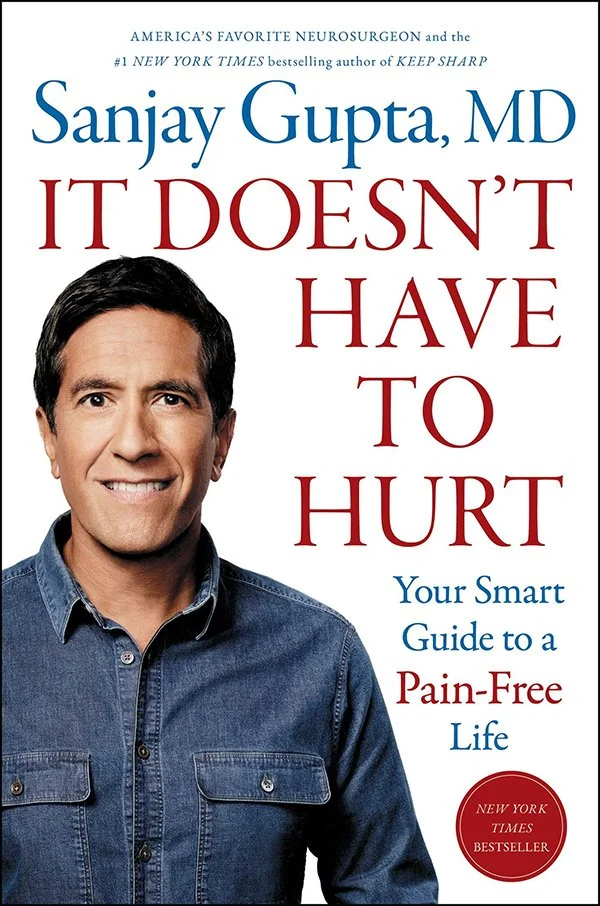
It Doesn’t Have to Hurt by Sanjay Gupta is published by Simon & Schuster, $39.99
For those just looking for relief from pain, who, at least in the moment, are more interested in what they can do to end or prevent pain, not so much in what causes it, Dr Gupta lists risk factors one can change. Chronic stress, inflammation, sedentary lifestyle, depression, anxiety, and social isolation, to name a few.
Preventive steps one can take include managing a healthy diet and weight, regular exercise, eliminating excessive alcohol and smoking. Steps that direct one towards an opioid-free pain care. But wait, did you know that our bodies produce natural forms of these same chemicals? Yes you did, you just called them endorphins, or what you feel after an exercise session!
Pump up the endorphins, decrease the pain, advises Dr Gupta.
Move more, he exhorts, quoting rheumatologists who preach “motion is lotion” for everything from chronic back pain to arthritis. Two minutes every hour – a mere two minutes! – can yield results.
He shares the seven reset strategies he’s created for “pain-smart” living. One, in particular, stands out. “A brief lapse of judgement can lead to a lifetime of pain... don’t paralyse yourself with fear that you might hurt yourself – but do anticipate that possibility... Here’s the shorthand: If you’re wondering whether a situation is safe, it’s probably not safe enough to attempt.”
Filled with fascinating details from a multitude of studies, It Doesn’t Have to Hurt is a book not only for those who suffer chronic pain or have people in their lives who do, but also for those who are looking for physician-approved ways to mitigate or prevent pain altogether.
There is so much hope in the words of this neuroscientist: “All pain is created by the brain. Because the brain is neuroplastic, always changing, chronic pain can change. Each time you remember this, you are training your brain to anticipate this possibility.”