
SPOTLIGHT
RAAG-MALA SEASON OPENER A MANY SPLENDOURED ARTISTE
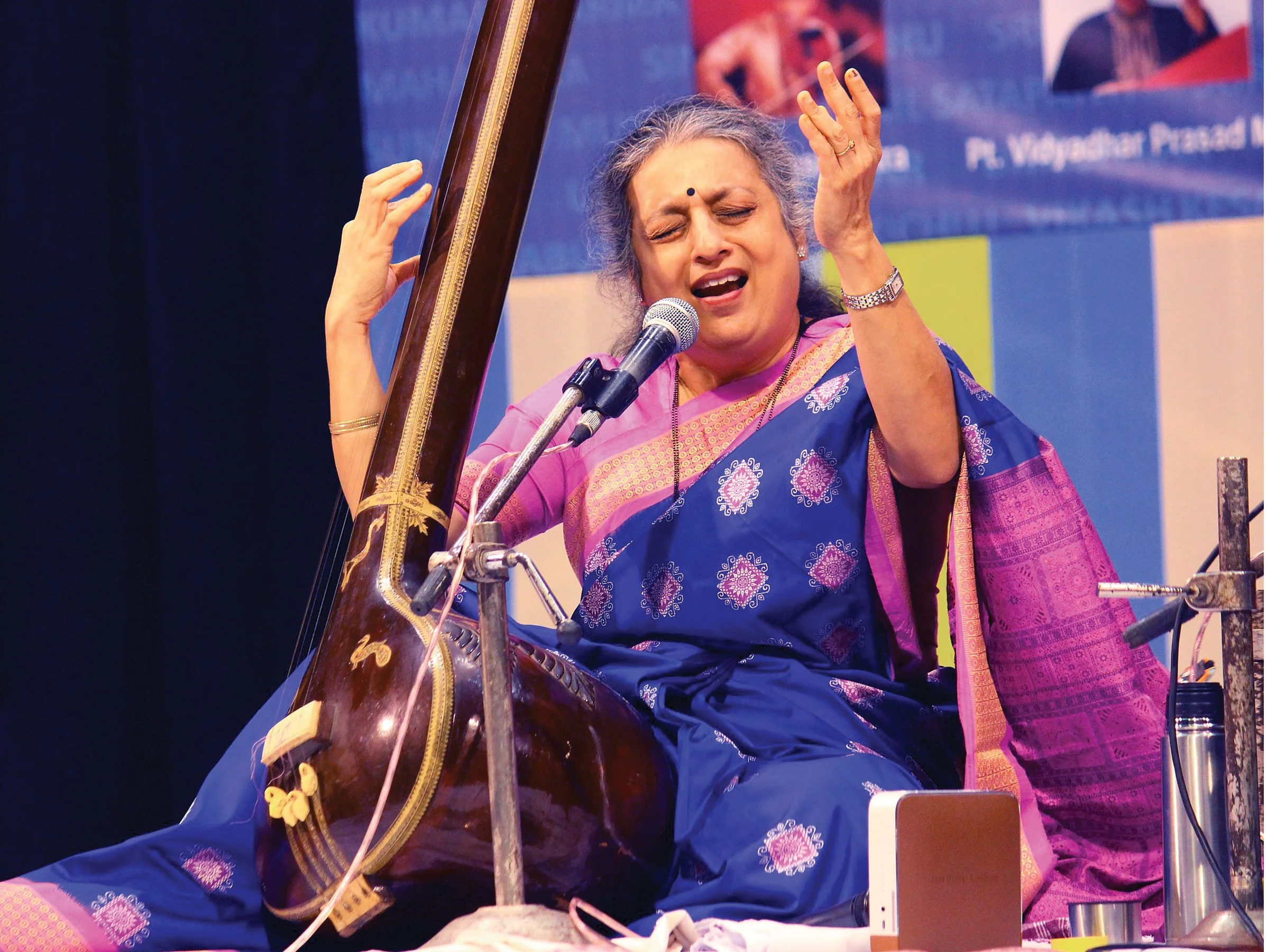
Vidushi Ashwini Bhide-Deshpande will perform at Raag-Mala’s upcoming 2026 season opener on April 3 in Toronto.
By SAMIDHA JOGLEKAR
“I have cassettes, some of concerts that I organized at my home in Thunder Bay. Great artistes like Ashwini Bhide-Deshpande came to stay with us. I have digitized them and no longer need them. Would you like to have them?”
These were the words of Som Naimpally, an accomplished mathematics professor, and my friend Ravi Naimpally’s father. At the time, I didn’t realize that I was being given a treasure: recordings of Ashwini Bhide Deshpande that would become an endless source of learning and inspiration.
For students of raag sangeet, including myself, one of the great challenges of the art form is learning the disciplined, well-thought-out exposition of a raag (musical scale) – presenting it in a way that is faithful to its notes and chalan (melodic movement). The goal is to remain true to the “character” of the raag while offering phrases that are aesthetically pleasing and genuinely innovative, all within an established rhythmic cycle such as a 16-beat taal. This demands a lifetime of dedicated practice and quiet humility. A restless mind is no one’s friend, least of all a student of raag sangeet. It can be common for the mind to dart ahead: instead of settling on a note with full attention, a learner may worry, “What note do I introduce next?” In my case, my gurus would gently insist, “Spend more time on that note. Find different ways of reaching it. There are many possibilities with just three or four notes. This note deserves your attention; it is the vadi (focus note) of the raag.”
The instructions seemed simple, but the execution was not.
Then I began to listen closely to Ashwini ji’s recordings, and I could hear what my gurus had explained being exquisitely executed. My erratic mind became quiet as I listened; I felt a deep, serene stillness from her very first note. Her singing was precise – steady and systematic – but also soulful and expressive. The movement of her voice from one note to the next was smooth, seamless, and graceful, full of emotion but with intellectual depth. Her music contained so much of what I longed to understand about raag sangeet and embody in my own practice, and I found myself devoted to learning more about Ashwini ji.
Vidushi Dr Ashwini Bhide-Deshpande, a recipient of the Padma Shri award in 2025, is recognized as an outstanding and highly distinguished artist of the Jaipur-Atrauli tradition of khayal singing founded by Ustad Alladiya Khan in the late 19th century. She has been widely regarded as a true torchbearer of this gharana, worthy of carrying forward its rich and demanding legacy. She received her initial training from her mother, Shrimati Manik Bhide, herself a highly accomplished disciple of the renowned vocalist Vidushi Kishori Amonkar. Alongside being an exceptional vocalist, she holds a PhD in biochemistry. Several writings about her musicianship say that the rigour of her academic training shines through in the clarity and structure of her music. She is an artiste who understands that music can be both art and science, and whose mastery is deep to a level that what stands out most to a listener is not necessarily her unerring grasp of raga grammar but how deeply her music moves them.
As the years passed, my admiration for Ashwini ji’s music only grew. Growing up in Canada, but in a culturally Maharashtrian home, my parents had her albums in their collection. The recording of her Raag Bheempalasi was a fixture of our household listening. I played many of her recordings on repeat – Vachaspati, Bhoopeshwari, Nand, Puriya Dhanashree, Jog, and more. While living in Mumbai in the early 2000s, on a break from my academic studies to focus on learning raag sangeet, I would inquire about where Ashwini ji was performing next, planning how to attend each concert if I could somehow find my way there.
Over time, I have been continually amazed by Ashwini ji’s brilliance as an artiste. In addition to being a wonderful performer, she is also a composer of many beautiful bandishes, an insightful explainer of jod-raagas, and an artist equally at ease in lighter forms such as thumri-dadra and bhajan-abhang. Her concerts often include Sanskrit stotras and stutis, which she delivers with the same depth and sincerity as her khayal presentations. In more recent years, I have been drawn to her series Raga Ki Tasveer (The Picture of a Raga). In this series, I have heard her describe raags as formless yet possessing distinct character and personality, like individuals we can befriend and build a relationship with. For me, this has become a beautiful guiding idea, reshaping my understanding of what makes music so magical.
Taken together, these experiences – the chance gift of rare recordings, the steady guidance of gurus, and the living example of Ashwini ji’s artistry – have shaped not just how I listen to raag sangeet, but how I understand it as a path of discipline and devotion. Her singing shows how rigorous thought and deep feeling can coexist, how a raag can be at once an abstract set of rules and a living companion in our inner lives. It is that rare combination that makes her concerts unforgettable.
Raag-Mala’s upcoming season opener on April 3 is therefore not to be missed for anyone who wishes to experience an extraordinary evening of raag sangeet in the hands of a truly amazing artiste; it promises to be one of those rare concerts that stays with you long after the final note has faded.
When and where: April 3 at the Nanji Family Foundation Auditorium, Aga Khan Museum, 77 Wynford Drive, Toronto. Details and tickets at www.agakhanmuseum.org.