
DESI DIARY
THE TIES THAT BIND BENGAL AND JAPAN
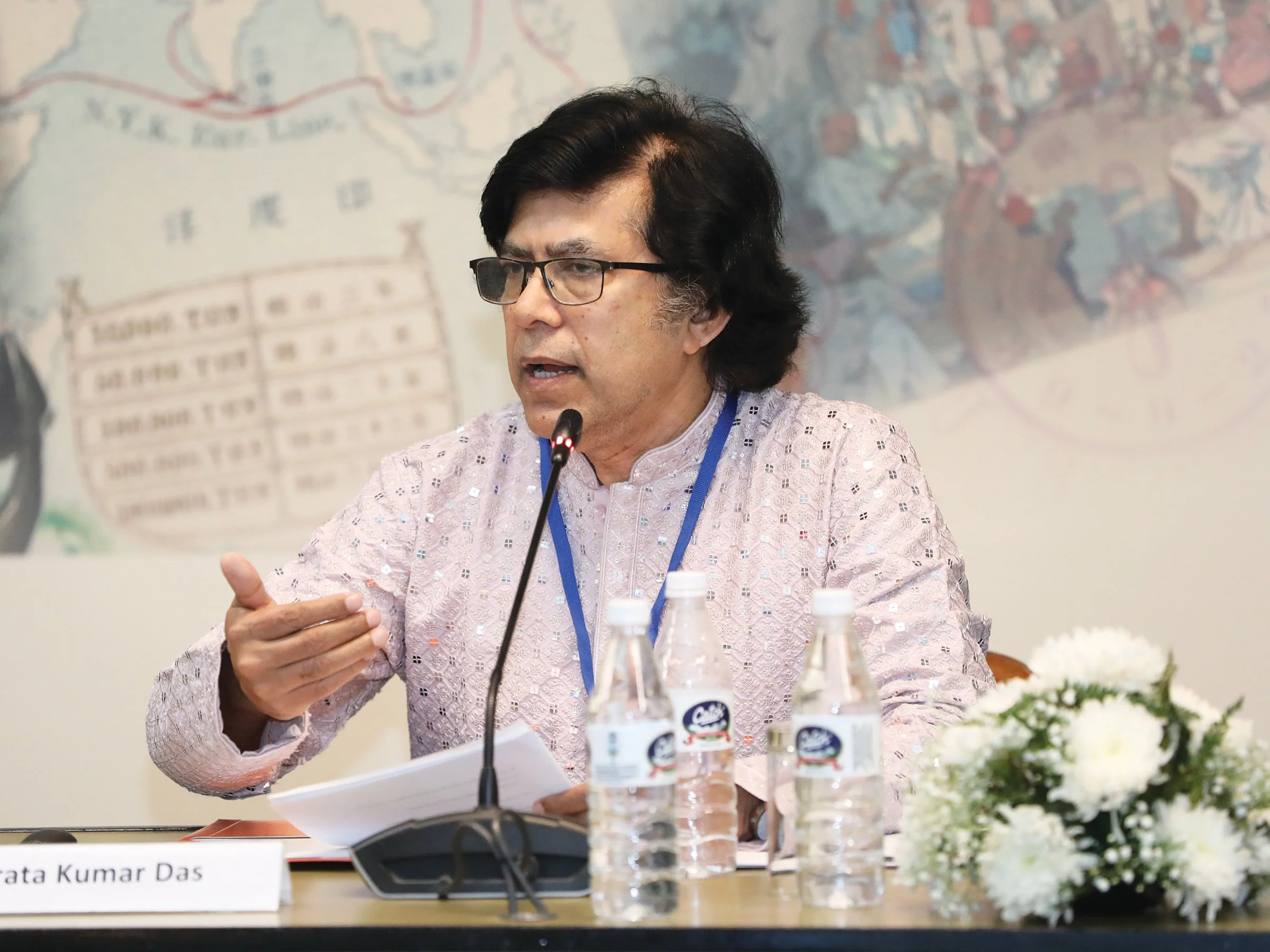
Subrata Kumar Das, delivering his speech at the three-day international conference on India-Japan: Lived Seasons and Intercultural Encounters, held in New Delhi, India.
By SUBRATA KUMAR DAS
I recently attended a three-day conference on the shared history of Indians and Japanese over the years.
My focus at India-Japan: Lived Seasons and Intercultural Encounters, was the relations between Bengal and Japan more than a century ago.
The enlightening and enriching conference was organized by Kizuna India-Japan Study Forum in collaboration with the India International Centre (IIC) and was attended by a good number of scholars from around the world.
Supported by the Japan Foundation, Delhi, and the Indian Council for Cultural Relations (ICCR), this conference successfully initiated the exploration of the historical relations between India and Japan.
The fact is I have never been to Japan, nor do I know a single letter of the Japanese alphabet.
However, I have been engaged in Japan-Bengal studies since 2007. In 2006, I had the opportunity to attend a conference in Rome, organized by UNESCO.
Upon my return, Rose Sabanal, a teacher from Japan expressed her interest in working with me. We, two teachers from Bangladesh and Japan, agreed to engage our students in a book writing project.
When I felt the need to share some knowledge about Japan with my Bangladeshi students, Rabindranath Tagore’s book Sojourn to Japan (1919) came to my mind. As I delved into other Bengali books written after Tagore’s, works by Bengali master writers like Buddhadeva Bose, Annada Shankar Ray and Narayan Sanyal captivated me.
During my research, I learnt about Hariprobha Basu Mallik, a Dhaka-based Brahma woman who married Uemon Takeda and visited her in-laws’ land in 1912.
Her book, Bongo Mohilar Japan Jatra (A Visit to Japan by a Bengali Woman) was published in 1915.
This information fueled my curiosity leading me to discover Manmatha Nath Ghosh who visited Japan in 1906, stayed there for three years and wrote three books on his experience. His first book, Japan Probas, published in 1910, inspired me to publish a centenary edition of the book from Dhaka.
I also unearthed a wealth of articles published on Japan in periodicals from cities like Calcutta (now Kolkata), Dhaka, and Faridpur in Bengal. Out of about one hundred articles I selected eighteen and published an anthology from Dhaka in 2012, placing Tagore’s article at the end to emphasise the pre-Tagore connections between Japan and Bengal.
I am pleased to share that my works have received new editions from Kolkata and I recently published a centenary edition of the Bengali book on Japan by Prof. Benoy Kumar Sarkar based on his 1915 visit to Japan. Additionally Jadavpur University Press has agreed to publish my English translation of Sarkar’s book.
My research on Japan-Bengal led Dr. Sushila Narsimhan to invite me to their recent conference at IIC, Delhi, from March 6 to 8. I was the only participant from Canada among scholars from various parts of India, Japan, Australia, the United States, Russia and Singapore.
The conference was divided into four themes – Cultural Connections, Facets of Community, From An Artist’s Iris and Textual Narratives.
I contributed to the last theme with my presentation titled Bengali Encounters with Japan After Its Opening: News, Translations and Intellectual Currents.
I also participated in Anglo/Bangla Canadian Canticles last month (April) in which I presented 5 Poets Breaking Into Song (#22) with noted poet George Elliott Clarke at Canadian Music Centre in Toronto.
Featured poets included Ayesha Chatterjee, Louise Bernice Halfe and Giovanna Riccio.