
SPOTLIGHT
LOVE, LONGING AND UNSPEAKABLE LOSS
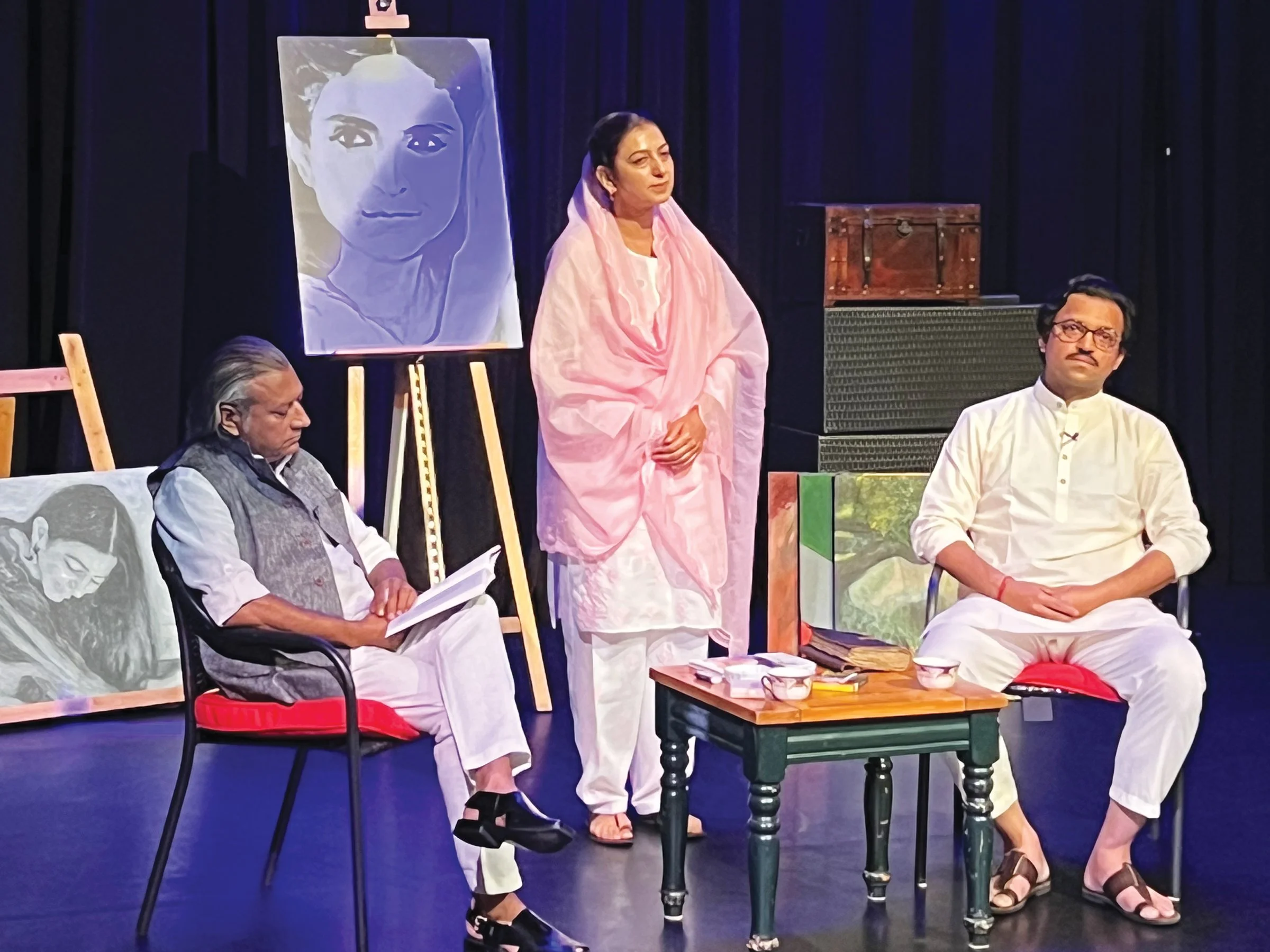
L-R: Akhil Pandya as Sahir Ludhianvi, Manmeet as Amrita Pritam and Guru as Imroz in Do Saaye Ek Amrita.
By SHAGORIKA EASWAR
Amrita Pritam’s poem, Aj aakhan Waris Shah nu kiton qabraan vichon bol, is a haunting reminder of the trauma of the Partition of India.
I heard it again recently while watching scenes of the largest migration of people in history as depicted in the television series Freedom At Midnight, based on the book of the same name by Larry Collins and Dominic Lapierre.
And then, within days, in one of those coincidences that never fail to amaze, again on stage, as Manmeet brought the words to life, playing Amrita Pritam in Do Saaye Ek Amrita.
The play, produced by Adaakar Arts, explores what happens when two men, bound by the love of the same woman, meet beyond time.
Do Saaye Ek Amrita imagines an intimate conversation between Sahir Ludhianvi and Imroz, two men whose lives were forever shaped by Amrita Pritam. One carried her as an unfulfilled yearning, the other lived beside her as a devoted companion. Through memories, poetry, silences, and confessions, they revisit the woman who transformed their lives.
As Sahir and Imroz reflect on love, loss, longing, and companionship, Amrita’s soul becomes a silent witness, sometimes observing, sometimes remembering, and sometimes gently guiding the conversation.
Beginning with Amrita recalling an incident from her childhood which defined her thinking and approach to life, the play delved into the deepest feelings and emotions of a woman who longed for an acknowledgement of love, and yet was fiercely independent.
As the two men reminisce over their love for the same woman, we learn that while Imroz, whose name means Today, was indeed her present for decades, Sahir was not necessarily her past as he was ever-present in her thoughts.
Each appears to be almost trying to convince the other of Amrita’s love for him.
“Maine usey likha, tumne usey padha (she was part of my poems, I wrote of her, but you read her),” Sahir tells Imroz.
“Tumne usey mohabbat di, maine ghar diya (you gave her love, I gave her a home,” Imroz responds. When she was unwell, along with the medicines on her bedside table were Sahir’s poems, he says.
Through the lyrics – all by Sahir – of timeless songs such as Chalo ik baar phir se, Lutey dil mein diya jalta nahin, Main jaanta hoon ki tu ghair hai magar yoonhi, Abhi na jao chhod kar, ke dil abhi bhara nahi, and Jaane woh kaise log the jinke pyaar ko pyaar mila, they traced the passage of time in their lives.
But then “Sahir” also quoted lines from Waqt ne kiya kya haseen sitam, which is by Kaifi Azmi!
Manmeet was Amrita Pritam in all her strength and vulnerability. When I think of how she had portrayed Sahir Ludhianvi in the Sawitri Theatre Group’s production of Aapka Khayal Aaya, I am blown away by her talent.
Akhil Pandya as Sahir, Guru as Imroz and Dhruva Dwivedi who introduced the cast, were all wonderful.
At the risk of coming across as a curmudgeon, though, I have to add a note about my pet peeve. All these talented people who treat us to plays in so many Indian languages can’t seem to get their kh and gh right. And so each gham, khud, khatam, khat, khayal... is like the scratch of a nail on a chalkboard – painful.
But maybe that’s just me and my idiosyncrasies, and the other offerings at the festival were varied and equally interesting.
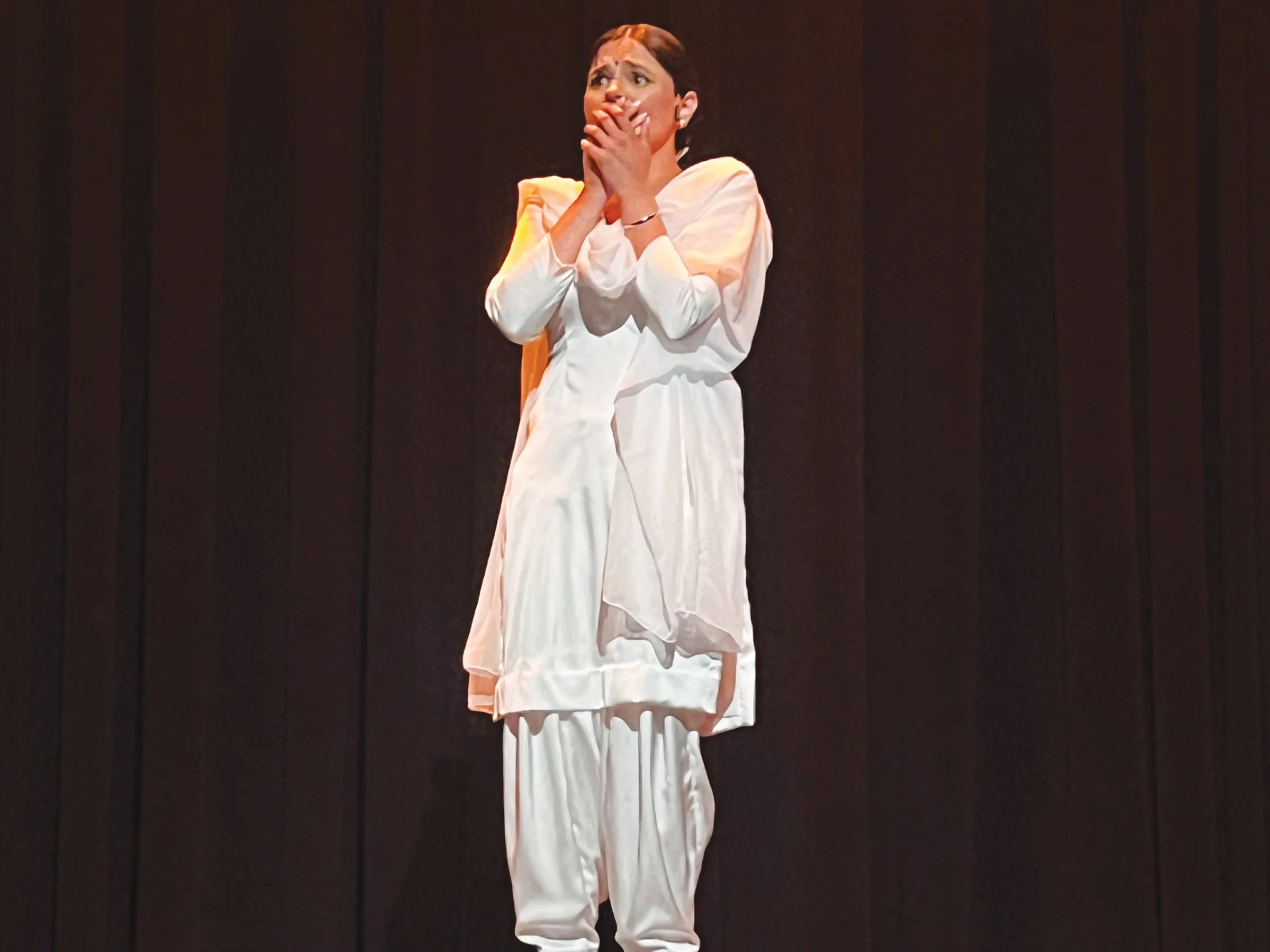
Taran Bhamra in The Amber Grey Sky.
“This is not just a play, and the people you will see on stage are not just characters. Every word, every tear, and every moment of silence in The Amber Grey Sky is woven from real-life stories and true historical events. It brings us face-to-face with a painful, deeply personal chapter of our past; one that lives as a faded memory for some and as a very sharp, stark reality for others.”
These lines from the press release about The Amber Grey Sky are not just words strung together, they describe an extraordinary performance.
Rooted in true events from November 1984, the play transforms historical trauma into a powerful theatrical experience.
Taran Bamrah plays Amarjeet, a young woman whose life was brutally taken in the 1984 riots that enflamed India. Alone on the stage for the entire duration of the play, she also voices other members of the family – her parents, brother, sister-in-law, her niece and toddler son – and neighbours and acquaintances. You might imagine that would be a bit of a stretch, but watch her transform from a happy young woman back home in Kanpur with her child for a holiday while her husband in Canada prepares to buy a new home for the family in Brampton to a woman who realizes there is no escaping the madness that is about to engulf them all.
It’s a bare bones stage. A calendar on the wall, a photograph on a table, and a blood-stained shawl. And with these, she wields magic. Bringing a smile to the faces of those in the audience as she plays with her child, laughing with delight at his efforts to catch her, she asks her mother why she hasn’t yet made kadhi-chawal for her, she chats with Gupta uncle, their neighbour, who wants to know if mangoes are available in Canada. But through an immersive soundscape designed by Navjot Singh Narula, the horror comes closer by the hour.
And you witness the horror through her, experience her terror, as she wonders how to protect her infant son as she peers fearfully from behind curtains at the black crosses that identify the homes of Sikhs on their street. Having lived through the Partition of India, her father knows well the “smell of a coming storm”. Her hopes flare as she sees Gupta uncle with a group of men wielding iron rods – surely he will come to their aid, say these are good people, they are family? And she watches him walk away and bolt his door.
We all know the history. We have watched several depictions of the events that unfolded across the country on those fateful days in 1984 on film. And yet, this production in an intimate setting is gut-wrenching and heartbreaking like few others. And then you realize this is really not just a story, not a composite of some people somewhere, but the story of a real family, with photographs and passports – and a death certificate. It’s very difficult to watch – you can’t pause a live performance to catch your breath – but watch one must.
After the performance, writer and director Sarabjeet Arora said, “By preserving these stories on stage, we hope to foster intergenerational dialogue, reflection, and a deeper understanding of the sacrifices and the triumphant resilience of the human spirit. As the audience, we aren’t asking you to just sit back and watch a performance. We are inviting you to hold space for these true stories, to feel the weight of human sacrifices, and to listen closely to the echoes of a past.”
Produced by Think Brown Media, The Amber Grey Sky does not shy away from the harsh realities of the past. Instead, it asks the audience to bear witness to the profound resilience of those who endured it.
Both plays were part of the Mississauga Multilingual Fringe Festival (MMFF) presented by Sawitri Theatre Group, bringing 48 performances of 12 plays to AN1 Studios and Sampradaya Theatre in Mississauga.
With all of the proceeds going to the artistes, it is a great way to support local talent. So mark your calendars for MMFF 2027!